
Art is created to be looked at. And if art is created to be looked at, then walking into a gallery, you believe yourself to be in control, the one doing the seeing. You are stoic, perceptive, confident in your power as a consumer, lover, and judge. This façade breaks, however, as the further you walk down the corridors, the more you realise you are not alone. For every set of painted eyes you meet, you feel them looking right back, unflinching, unblinking. You came as the observer. Yet by the time you leave, it’s hard to shake the feeling that you were the one being observed all along. It’s as if they are aware of your presence. And worse—they might be judging.
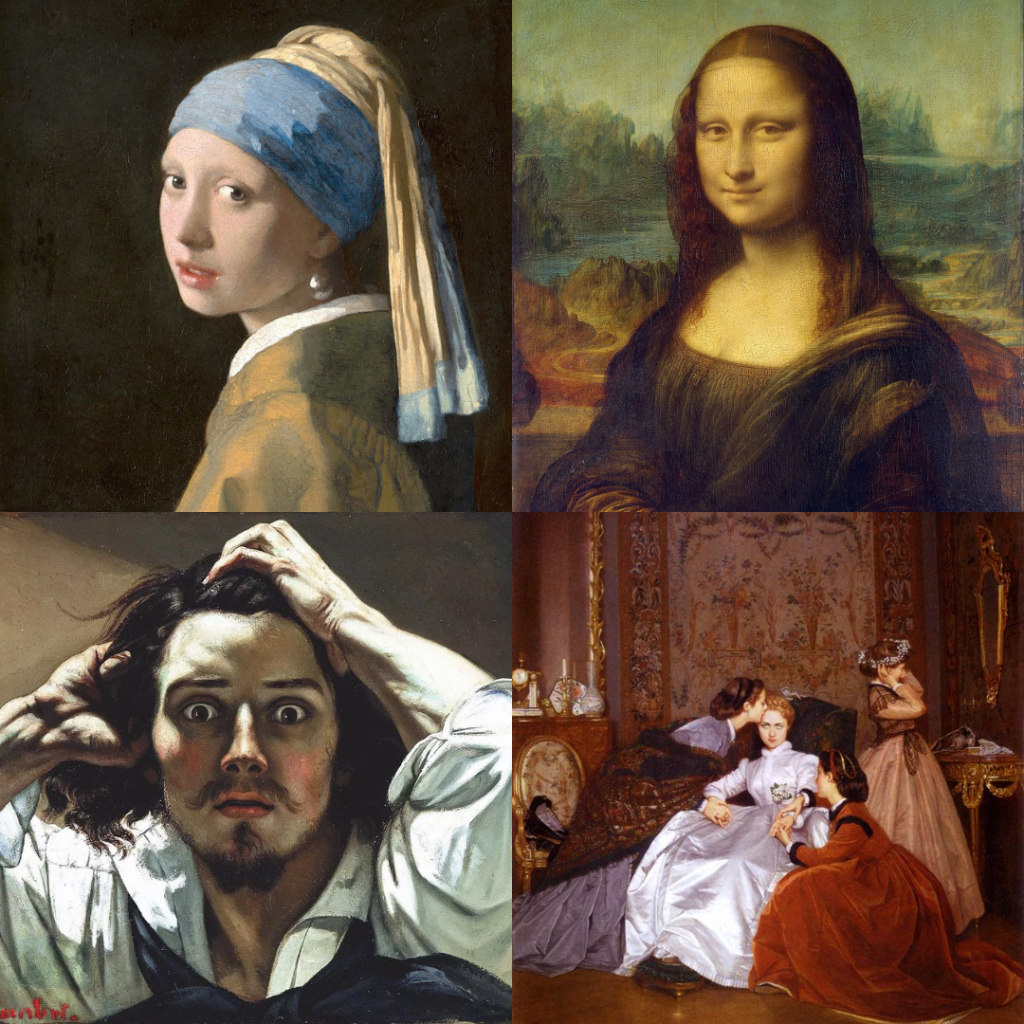
Across history, the gaze captured within paintings has held a unique power to stir emotion and provoke reflection. Take Johannes Vermeer’s 1665 masterpiece, Girl with a Pearl Earring, for instance. One look, and you’re caught. Her stare is tender, almost pitying, and through this hypnotic standoff, you can’t help but wonder the famous question: Is she turning toward you, or away? She acknowledges you, and in doing so, makes you real. Nicknamed the “Mona Lisa of the North,” Girl with a Pearl Earring has long been the centre of debate for art historians. With no clear narrative, no setting, and no named sitter, a certain mystique is ignited, leaving us alone with that haunting stare. It’s this eerie sense of awareness that gives portraits like Vermeer’s the ability to remain timeless, being admired not only for their technical brilliance but for provoking the startlingly intimate feeling of being seen.
Even if the motionless stare of a portrait unsettles us, we are soon comforted by the knowledge that the subject remains suspended in a single moment, not lucky enough to be blessed with physical agency. That is until you move to the other side of the room and find that they are still looking straight at you. This strange occurrence has been dubbed the ‘Mona Lisa Effect,’ a phenomenon where the eyes of a subject seem to follow the viewer around the room. It has fascinated and unnerved art lovers for centuries, and, as its title would suggest, originated with Leonardo da Vinci’s famous muse. Though her eyes are in fact subtly askew, looking 15.4 degrees to the right of the viewer, many have testified to her enjoyment of chasing her admirers around the Louvre. Beyond the illusion, the impact of the stare goes deeper than just a two-way exchange. Our brains are wired to interpret faces and particularly eyes with acute sensitivity. Eye contact, or the impression of it, triggers a cascade of cognitive and emotional responses. This ability inspires artists to utilise the gaze as a tool, triggering a primal response that enhances the realism of their work through facial recognition.
Along with influencing emotion, the stare has long been a site for asserting power dynamics and shaping interpretation. As art evolved through the ages, so too did the role of the gaze. In The Desperate Man (1845), Gustave Courbet, a pioneer of the Realist movement, portrays himself with wild, frantic eyes that don’t just look at you; they accuse you, revealing unspoken secrets only understood through the intensity of the eyes. Meanwhile, Auguste Toulmouche’s The Hesitant Fiancée (1866) offers us a different kind of stare, one charged with vexation. Known for his detailed depictions of bourgeois life, Toulmouche captures a young woman whose wary, irritated expression holds us at bay, brimming with anger, as if we are somehow complicit in her situation. In the guilt that follows, we find ourselves connecting with her, understanding her position. These are not just glances; they are invitations, and sometimes challenges, to step closer. To see and be seen.
In contemporary galleries, this dynamic has shifted. Modern and postmodern art often deliberately obscures or disrupts the stare. Subjects are turned away, fragmented or blurred. Even when faces are present, their eyes are often obstructed or erased entirely. This visual detachment reflects a broader cultural move toward anonymity and the breakdown of identities. Yet, this doesn’t mean the viewer has reclaimed their once revoked dominance. On the contrary, modern gallery spaces themselves are curated to make us feel observed, not by painted eyes, but by the institutional gaze of art itself. Security cameras, bright lighting and even the blinding effect of stark white walls create an atmosphere where you are the one being primed for study. The paintings may not be watching anymore, but the space is.
So next time you step into a gallery, notice how quickly your confident stride falters under painted scrutiny. And when you find yourself staring back, lingering a moment too long, ask yourself what it is you’re looking for. Or, perhaps more unsettlingly…what they see in you?
By Liv Willson