
By Jessica L. Smith, Senior Opinion Editor
Jesus died for somebody’s sins, but not mine.
Fifty years ago, Patti Smith’s raspy, poetic voice burst onto the New York City music scene with a debut studio album marked by this striking opening line. When I saw Smith bring her Horses 50th Anniversary Tour to London earlier in October, the very same line opened her set to a roaring, affectionate crowd. Smith’s voice exploded into the London Palladium, signalling the start of a spirited performance. By some fluke of rare ticket purchasing luck, I witnessed this triumphant moment from the third row in a state of sheer euphoria. Stepping into the spotlight, Smith’s silver hair glowed brightly, ironically reminiscent of a celestial figure as she sang her line about taking personal responsibility for her actions. Such a potent, enthralling opening line marks an album defined by one overarching concept: freedom.
Smith released Horses in 1975 amidst a counter-cultural era seeking artistic, social, and sexual freedom through rock and roll. Marked by a sense of urgency and angst, I believe that Smith’s revolutionary lyrics call for liberation in a compelling manner. ‘Gloria’, the album’s opening track adapted from Van Morrison’s version of the song, intertwines a queer narrative with Smith’s own sense of independence and freedom. Building up from a misleadingly soft piano to accompany the gritty lyrics of the song, when Smith’s band kicks in the momentum of ‘Gloria’ is propelled into eliciting a transformative release. Smith not only sings of claiming her sins as her own, but of her asserting her right to follow her own rules, which I feel cements her unconventional call for freedom. Smith reiterates this throughout Horses, perhaps most poignantly in ‘Break It Up’, in which Smith’s lyrics delve into a narrator who tears their skin off, turning into an angel and flying away from their hellish existence into a state of freedom. Or perhaps it is the lengthy track ‘Land’, with its building tempo and repeated chants of ‘Horses!’, that conjures up a cathartic image of freedom and possibility through the wild, unpredictable nature of Smith’s music. Even taking one look at Smith’s androgynous style on the cover of Horses reminds us of the crucial freedom of expressing one’s own self.
For me, Horses is an enduring album, withstanding the test of time as proven by the sea of fans flocking to the 50th anniversary tour. Yet, I believe that it is not just Smith’s punk rock energy, abstract lyricism, and daring sound that has contributed to the album’s longevity, but how her urgent call for freedom remains pressing today. Today, we find ourselves in the absence of counterculture, unlike Smith during the release of Horses. Yet, freedom remains at the tip of our tongues. Smith’s confrontational album and message of freedom remains ringing in our ears when we see our freedom of expression being threatened by authorities clamping down on activists, or the thunderous evolution of AI continuing to transform our freedom of artistic expression. Perhaps most notably, however, within the rising entrenchment of the far-right in our political sphere.
Right-wing ideas are certainly clawing their way back into society after years of a fairly liberal consensus. In the UK, we see this epitomised by the rising popularity of Reform UK and its infamous leader, Nigel Farage. If elected, Reform UK’s day one priority is to withdraw from the European Convention on Human Rights (ECHR), which was established in the 1950s to ensure the atrocities of World War II are never repeated. Farage has also pledged to repeal the UK’s 1998 Human Rights Act and 2010 Equality Act for a ‘British Bill of Rights’, a replacement that would make no mention of human rights and only apply to UK citizens or those with a legal right to live in the UK. The thread connecting these pledges is immigration, particularly Reform UK’s plans to tackle the deportation of migrants arriving illegally. If Reform UK’s self-conscious prejudice toward ‘foreigners’ gets its way, our human rights and fundamental freedoms will be withdrawn. Human rights protect us all, not just migrants. Reform UK and, more specifically, the reawakening of right-wing ideas is echoed elsewhere in the world, not just in the UK. For instance, in October, Japan elected its first female Prime Minister, Sanae Takaichi, who is known for her conservative views that oppose boosting gender equality and for seeing Margaret Thatcher as an inspiration. Undeniably, Smith’s call for freedom suddenly seems imperative.
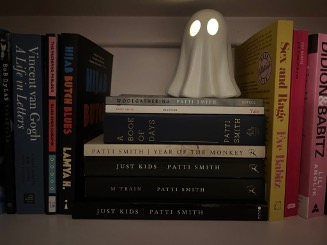
Interestingly, I have noticed that Smith has seen a recent rise in popularity through the social media platform of TikTok, where the virality of her 2010 memoir Just Kids has captivated an ever-growing audience. Just Kids evocatively documents Smith’s relationship with photographer Robert Mapplethorpe amidst the exciting landscape of New York in the 1970s. It is thought-provoking, then, that at a time where right-wing ideology is resurging, to find Smith’s work also rising in popularity. Is Smith re-emerging because, once again, exactly fifty years since Horses, society needs her creative call for freedom?
Smith’s own profound belief in the power of individual expressions of freedom has not faltered since Horses. In her 1976 interview with Lennart Wretlind in Stockholm, when asked what freedom meant to her, Smith embodied the spirit of rebellion in her reply: “Freedom is inside of me. It means that I’m not hung up with, like, anybody’s idea of how I should be. You know, I’m outside of society. I’m an artist. Rock and roll is my art”. Today, Smith continues to utilise her platform in regard to her own freedom of speech. Smith runs a Substack page, a subscription-based publishing platform, where she has accumulated a cult following and uses her corner of the internet to continue advocating for peace and freedom, often sharing stories and poetry to aide this. This summer, Smith published a reflective video on the 80th anniversary of the Hiroshima Bombings, in which she weaves through her feelings of despair and helplessness at how this devastating piece of history is echoed today in Palestine.
Exercising her freedom has certainly never left Smith’s mind since the release of Horses in 1975, a move that I believe should remain at the forefront of society today. Before closing her set at the London Palladium with the protest song ‘People Have the Power’, Smith erupted into an impassioned cry, urging us to use our voices in a unifying call for freedom. Throughout her set, Smith spoke her mind on American politics and the genocide in Gaza, dedicating her song ‘Peaceable Kingdom’ to the people of Palestine. I find Smith’s unwavering commitment toward being a vocal advocate for freedom inspiring. It is about time that, with the rise of right-wing ideology, society is finally catching on to the need for Smith’s call for freedom once again
Image taken by the author.