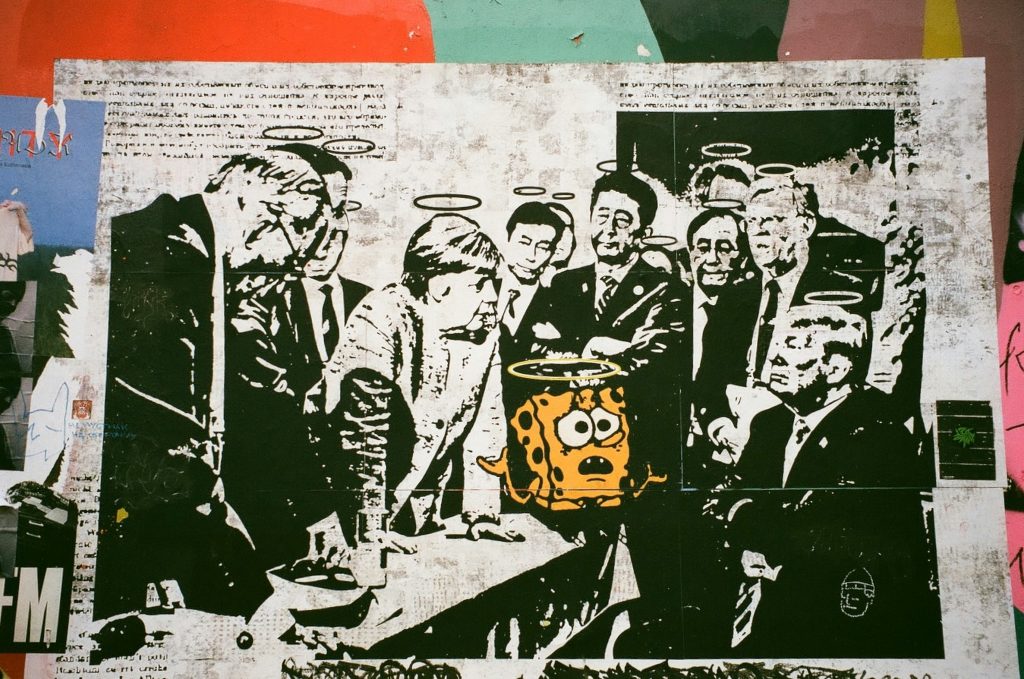
Photo by diana kereselidze on Unsplash.
By Isobel Carnochan, Associate Lifestyle Editor
Last Autumn, Hayden Anhedönia, professionally known under the stage name Ethel Cain, posted a rant on Tumblr expressing her frustration at the modern obsession with reducing everything to an online joke. It sparked some controversy, and she was accused by many of ‘compliment fishing’, but I’m pretty confident that the majority of us can see where she was coming from. Every time I make the misguided judgment of opening the proverbial door of Instagram, X, or TikTok, an onslaught of shallow jokes about anything and everything seem to fall into a jumbled heap at my feet. The most concerning of these jokes? The ones about global politics.
Zelenksyy’s infamous meeting with the White House was, admittedly, quite a while ago now. And yet, I haven’t been able to stop thinking about it. More specifically, I have not been able to stop thinking about the internet’s response to it. The situation in Ukraine grows more serious with each day Russia’s occupation continues, and the UN refugee agency estimates that roughly 12.7 million people in Ukraine are in need of humanitarian aid in 2025. Zelenksyy’s meeting with the White House was supposed to ensure security support from America, in return for America having access to the rich mineral land of Ukraine. Trump, however, chose to defend Putin and accuse Zelensky of being a dictator, criticising ‘the hatred’ he had for the Russian President. The tension eventually culminated in a shouting match, in which President Trump and Vice President Vance accused Zelenskyy of not being ‘grateful’ enough for America’s support. This was after Zelesnkyy had stated that American support would be ‘crucial’ to maintaining Ukrainian territory. Zelenskyy left the White House with no deal, and no support. As the war continues, America will not be helping. The lives that could have been saved by this deal will not be.
Yet, the internet seemed to have very little to say about the horrifying consequences of the meeting. Instead, it saw JDV Vance’s face edited onto a toddler’s body, accompanied by infantilised texts reading ‘you need to say pwease’.These images were everywhere, circulating every corner of the internet likean anti-intellectualist spectre. And, even worse, Zelenskyy’s interactions with other world leaders following this meeting were labelled ‘pettiness’, as if this was some juvenile playground dispute over a scraped knee or a deflated football rather than a serious political event with real and potentially devastating consequences.
Even more recently, the death of Pope Francis has seen more internet jokes about JD Vance ‘killing him’, due to the unfortunate timing of their meeting, than it has real concerns about how this might affect global affairs. Pope Francis wasn’t a radical by any stretch of the imagination – he was, after all, a Catholic pope – but his continued support for Gaza certainly deserves him some humanitarian credit. We can’t guarantee that the next Pope will share the same values. Pope Francis’ death ultimately could not have come at a worse time, and yet social media continues to make more comedic quips about JD Vance and unfortunate timing than it does the effect his death will have on humanitarian affairs.
This phenomena of treating global politics like a joke isn’t new. For as long as social media has existed – if not longer – politicians have been treated like children, ignorant to the harm they cause, stubbornly stomping their feet in rage until being placated with a lollipop[1] [ic2] . In the UK, Boris Johnson was referred to as a ‘bumbling oaf’ or an idiot more often than he was actually held accountable for his actions. And I’m not saying that politicians don’t do incredibly stupid things, because sometimes they do. But, more often than not, politicians themselves aren’t: they willingly take on the costume of idiots, or ‘bumbling oafs’, to avoid accountability. And, when social media perpetually reduces politics down to re-tweetable jokes and comedic one liner comments, we let them get away with this. Instead of recognising that these are facades meant to preserve their power, we have allowed serious events to become reduced down to silly jokes that detract from the danger these world leaders are actually posing. Social media does undeniably do wonders for raising awareness, but does this awareness actually help anything? Clearly, not as much as we would hope.
I understand the concept of humour as a coping mechanism, I really do. But, in cases like the White House meeting, I don’t feel like the majority of people making jokes out of it really have the right to do so. Sure, I can sympathise with the American plight: having Trump as a president surely warrants some unhealthy coping mechanisms sometimes, and the meeting with Zelenskyy made his inadequacy as a world leader (especially as the leader of, perhaps, the biggest global superpower of the twenty first century) all the more apparent. And, yet, this meeting imposes drastically different consequences for Ukrainians than Americans. Is it really their right to turn an event that will allow the continued massacre of Ukrainian citizens into a comedic tweet?
It’s even less our right to do so in the UK: it wasn’t only American citizens who were guilty of this, and yet we have even less justification for doing so. I understand that the knowledge that people are suffering at this very second in some other corner of the globe is troubling, but we’re essentially just laughing at someone else’s pain in order to help us forget about it. As we laugh the pain away, others continue to suffer. In my opinion, it’s beyond cruel. Worse still, it desensitises us from the reality of both pain and politics. Until the way we use social media to talk about world leaders changes, politics won’t. If we keep reducing every major global disaster down to a stupid joke that invokes witty replies or memes but nothing of actual substance, politicians will keep getting away with doing horrible things. When we make these jokes, we reduce in our minds how much power these people actually yield, and how dangerous this is. We ignore the manipulation that goes on in politics, the power plays and subtle indoctrinations, assuming these leaders are too stupid for them to actually do anything intentionally. We, essentially, become complacent with this continuation of suffering and inequality. It’s indescribably dangerous, and it needs to change.