
Before the symbol of the pomegranate fades completely into the background, no longer a faux-quirky image to wear on your person or to be used instead of a red heart as the emoji which you like messages with, I feel it is best to reflect on the myth of Hades and Persephone.
The ‘Homeric Hymn to Demeter’, the oldest version of this myth, is the basis for later adaptations. In the hymn, Zeus allows Hades to steal away Persephone as she is picking flowers. Her mother Demeter senses Persephone is gone and travels to find her. Demeter is led to the all-seeing sun charioteer, Helios, who tells her that “no one else among all the immortals is responsible except the cloud-gatherer Zeus himself” and that Hades will be an advantageous son-in-law.
Demeter refuses to see any of the gods and disguises herself to walk the mortal world. Demeter becomes the nurse of prince Demophon, who she rears as a god. Metaneira, his mother, catches Demeter attempting to burn away his mortality in the hearth and scolds the disguised goddess. Demeter is enraged by Metaneira heedlessness, reveals her identity, and orders a temple to be built to honour her.
Greving in the newly built temple, Demeter prevents all plant life from growing. Zeus notices the sacrifices from the humans are dwindling, so sends Iris down to call Demeter to a council. Demeter refuses Iris, and the many other gods Zeus sends, claiming she would not let any plants grow until she sees Persephone. Hearing this, Zeus sends Hermes to the Underworld who recounts the events to Hades. Hades tells Persephone to go to her mother and reminds her how powerful she is as the Queen of the Underworld, but gives her pomegranate seeds before she leaves. Hermes takes Persephone to Demeter, who rushes to see her daughter; exactly what occurs is unknown, as the next thirteen lines of the poem have been lost.
Demeter tells Persephone that when she brings spring, that is when Persephone must leave the Underworld each year. Persephone explains she ate the pomegranate seeds as she left, but that the original stealing of her was allowed by Zeus and not Hades. In eating the pomegranate seeds as she left it is implied, although not clearly, that the number of seeds correspond with the amount of time Persephone would alternate between Olympus and the Underworld. Mother and daughter rejoice at this compromise. Zeus tells his and Demeter’s mother, Rhea, to convey a message to Demeter: Persephone will spend two thirds of the year with her on Olympus, – it is not clear if this is due to the pomegranate seeds or not – and the other third with Hades in the Underworld. Hearing this, Demeter shows the kings how harvest rituals are to be performed and joins the gods on Olympus with Persephone once more.
This eldest surviving source puts more emphasis on Demeter than either Hades or Persephone. Interestingly, both the narrator and Persephone resolve Hades of any blame, and places the blame on Zeus instead for any misfortune caused. As Zeus, as an ancient Greek patriarch, has the ultimate say in matters concerning the Olympian gods, as they are all his family.
Adaptations of the myth for children, specifically The Usborne Book of Greek Myths, almost always place the blame on Hades. The god of the Underworld’s actions are deemed ‘unforgivable’, and he abducts Persephone with no blessing from her father. In fact, it is Zeus’ will that “Persephone be returned” from the Underworld, not married to Hades. It is befitting of our modern sensibility that since Hades stole away Persephone, it is Hades to blame. There is no longer a culture in the Global North of a father having ownership of his daughter. Therefore, it is not for Zeus to dictate, in modern adaptations, who Persephone marries. Yet Persephone still needs to end the narrative splitting her time between both realms, so must marry Hades. Therefore, the blame is moved from Zeus to other characters in the myth, a trend that continues in other adaptations.
In the video game Hades, the only change to the story of Persephone is the lack of resolution. The mortal world has been in peril since the abduction. Which, as the narrative is set a generation after Hades and Persephone are married, has been a significant length of time. While Hades, Persephone, and their son Zagreus become closer over the course of the game, Demeter remains frosty. One of her voice lines reads: “I wasn’t very kind to [Persephone], I think […] It was her mortal blood that made her weak! Born to mortals, taken by mortals, I suspect. So now, they pay.” The blame in Hades is set on Demeter. She is portrayed as an overly controlling mother due to Persephone’s status as a demi-god, rather than a full goddess, in the game; Demeter pushed Persephone away by restricting her, leading to Persephone choosing to marry Hades as an escape from her mother. The blame set on Demeter allows the game to rebuild the bonds between Hades, Persephone, and Zagreus, by elevating them of any wrongdoing in the dynamic of this family. It is the narrative focus on Hades which necessitates an evil Demeter.
Each of these versions of the myth point the blame at a different god who has power over Persephone. It is her father Zeus’ fault, no, it’s her husband Hades’ fault, no, it’s her mother Demeter’s fault! However, perhaps the solution lies in inverting this trend of blame.
Anaïa Mitchell’s Hadestown (2019) never fully confronts the abduction of Persephone. Though, from a cut verse in ‘Chant Reprise’, Persephone reveals it was her choice to go with Hades. The characters of Eurydice and Persephone are linked in this verse, with Persephone drawing a parallel between them: “when I was a young girl like you”. Their narratives act as foils to one another insofar as both their fates are dictated by their significant others after selling themselves to Hades. Mitchell, if this verse is to be included in the canon of the musical, therefore places the blame on Persephone for her relationship with Hades. She made a poor choice when she was young and now has to live with the consequences. The blame being set on Persephone increases both the agency, and the tragedy of her character prior to ‘Epic III’, which sees Persephone and Hades’ willingness to try again in their marriage. The increased tragedy of Persephone’s’ situation thereby intensifies the weight of their reconciliation, granting the narrative a stronger resolution.
Interestingly, when Persephone chooses to be with Hades, their relationship is never a happy one. In Hades she begins the narrative having left the Underworld seemingly for good; in Hadestown, Persephone does not wish to be with Hades any longer. The pair are never allowed to be wholly happy together. There is always someone to blame for this unhappy couple. Whether it is due to narrative reasons of modern adaptations in Hades and Hadestown, or cultural reasons in children’s retellings and the ‘Homeric Hymn to Demeter’, the blame in the myth of Hades and Persephone is always due to, or used as, a vehicle of larger change in the adaptation.
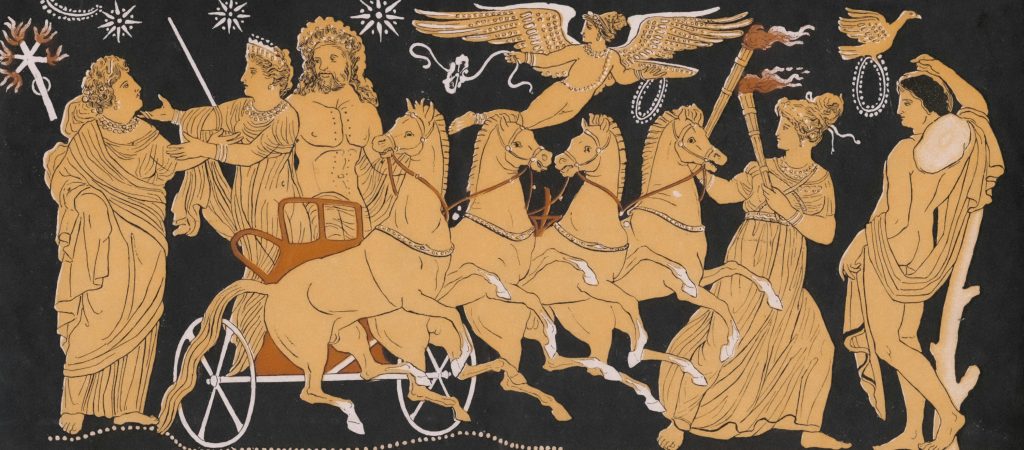
Image: The Miriam and Ira D. Wallach Division of Art, Prints and Photographs: Picture Collection, The New York Public Library. “Die Hinabführung der Persephone in die Unterwelt; Abschied von der Mutter” The New York Public Library Digital Collections. 1896. https://digitalcollections.nypl.org/items/510d47e4-0f4c-a3d9-e040-e00a18064a99 Published on October 6, 2024