
By Ruby Day and Kiera Garcia – Culture Editors
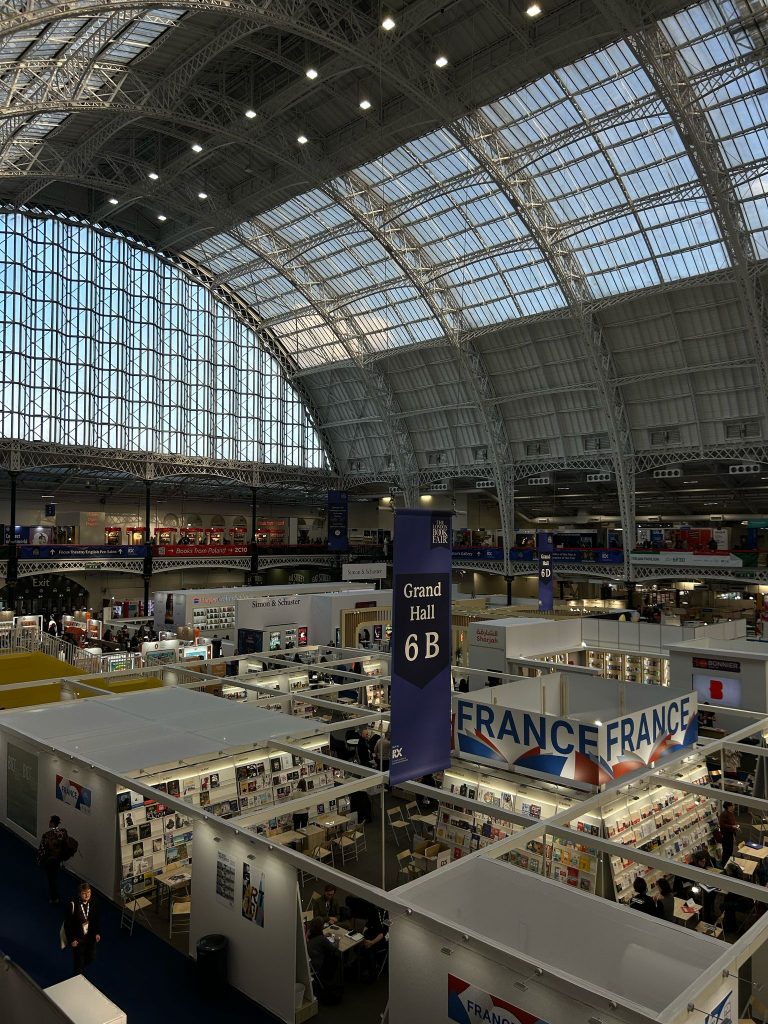
The Orbital’s Culture Section was lucky enough to be invited to this year’s London Book Fair. Taking place in the spectacular Olympia Exhibition Centre in Hammersmith, the LBF is an annual event for the many moving parts of the publishing world to interact with each other face to face. For us as student journalists, the experience was eye-opening, to say the least. Varying from revelatory talks on publishing ideologies to the more realistic personal interactions, here are the five things we took away from the 2025 London Book Fair.
- The Talks: what did the LBF want us to learn?
One main takeaway, clearly communicated by the London Book Fair, was that the publishing industry is becoming more inclusive by working to amplify diverse voices. Many of the talks throughout the three days of the fair platformed writers and industry professionals who stressed the importance of ensuring diversity in media. Two of the talks we attended had this same focus, one talk centring on accessibility within reading circles and how to cater towards those with reading disabilities, and the other focusing on platforming working class writers and providing them with more opportunities to have their work published.
In the talk on reading accessibility and encouraging both children and adults to read again, the speakers promoted alternative forms of literature consumption as an accessible entry into reading and stressed the lack of representation felt in literature by young people. Audiobooks were encouraged as a way to follow a story, especially for those with learning disabilities such as dyslexia who may struggle with the physical act of reading a novel. Furthermore, they discussed how the works taught within schools contain important messages but are antiquated. They argued that to encourage young people to read more, they need to see themselves reflected in the stories they read.
In the talk on the importance of working-class writers and readers, critique of the publishing industry was very much present. The panellists stressed that working class writers should not just be expected to write about the hardships of working-class life and instead should be encouraged to write what they want to. They discussed how supporting yourself as a working-class writer is difficult as the money that upper class writers may have to fall back on is not present. It was stressed that the discouragement working class individuals have around a career in the arts stems from youth, with the instability and unreliability of a career in writing steering them away from it.
These foci are important ones that need to be addressed within the industry. However, what the fair itself wanted to be perceived to promote was a divergence from the actuality, which will be highlighted later in the piece.
2. Career diversity in the publishing sector
I know that upon getting ready for the LBF, my understanding of the publishing industry was much more limited to big name publishers and the roles you typically hear about: writer, publisher, editor. However, after attending the fair, it became clear just how many different roles there are within companies and how many different strands of the publishing industry exist. Of course there were the big publishing houses, such as Penguin and Random House, but the presence of indie publishing companies did not go unnoticed. There were plenty of small publishers from around the country as well as international publishing houses.
During our breaks between the talks, we chatted to distributors about their roles and the marketing side of publishing. We also saw stalls for Spotify and Audible, showing that the world of audiobooks was expanding within the publishing sector itself. There were stalls representing museums and their publications, as well as the research database JSTOR. Walking around the London Book Fair quickly acquainted us with the sheer magnitude of what is considered the publishing industry. It was encouraging to see that it is not only the big names or the typical roles that can allow you to get a foot in the door.
3. ‘Dismantle the snobbery’: The ironies of myth and reality in the publishing industry
As mentioned, the talks we attended were lobbying for inclusivity and accessibility within the industry. Whilst some speakers were more critical of the establishment than others, there was a general recognition of the need for change that buoyed us with confidence to mingle with representatives manning the hundreds of stalls. Unfortunately, this gave us a rather rude awakening.
It goes without saying that to even be recognised as student journalists made our position far from underprivileged; nonetheless, an atmosphere of elitism did permeate our experience. The principles being expressed in the talks, by those ironically well-established in their professional publishing jobs, were not successfully reflected by other industry employees. To invite writers from university publications to report as press for free, and to offer reduced ticket prices for students wishing to experience the Book Fair, suggested inclusive intent of our attendance by the LBF organisers. This intent to accommodate non-professional attendees, however, was ultimately overridden.
Interacting with a handful of representatives quickly proved our status as student journalists was baffling and borderline-startling, despite our invitations and nifty press badges. We managed to speak to a few people who were willing to answer our questions on the importance of the Book Fair, and what they liked about it, but this was a rare instance of hospitality in a largely dismissive environment.
Admittedly, our experience is one out of many that will have occurred across the three days. We can in no way speak for the whole industry’s attitude towards accessibility. In clearly wanting student writers and career hopefuls to attend the fair, going on to promote the destabilising of the snobbery that pervades the industry, however, seemed like a step in the right direction. Unfortunately, it struck us as ironic that certain stereotypes were instead reinforced, in the same building in which they were being condemned.
4. Recognition or condescension?
In our second talk of the day, ‘Building a Diverse and Inclusive Reading Community’, some startling statistics were conveyed. Within the data, a distinction between the ‘reading by choice’ bracket and the ‘reading engagement’ bracket was made clear: reading engagement is the generalised concept of a reader’s experience, whereas reading by choice defines people who actively and often participate in reading-specific media. Alarmingly, the broad reading engagement bracket encompasses only 50% of UK adults (roughly 27 million people), down from 58% in 2018. A further breakdown of this revealed that 35% of this statistic were lapsed readers, marking a 15% increase in active non-readers in the last seven years. The country is rapidly becoming disengaged with purposeful reading, with 42% of young people (16-24 y/o) struggling to associate themselves with the fundamentally privileged ‘reading profile’.
Books, as a slow-burn, immersive entertainment experience, struggle to compete with the instant gratification of social media. The LBF made clear that it is no longer practical for screens to be seen as the enemy, publishing houses must perceive digital media as a gateway instead. Within this, another layer of elitism is revealed that those at the top were happy to criticise; the publishing industry has to reevaluate ‘right reading’, recognising that joke literature or the trashy novel is what the average person wants to engage with, which is valuable in itself, regardless of how cool you might feel opening Charles Bukowski on the train.
Yes, recognition of these issues is the first step to affecting real change for those disturbing statistics, and implementation of publishing’s inclusivity agenda is far from complete. It would have been nice, however, to see some of this praise for the unpretentious reflected in the representatives of the industry. Instead, as already emphasised, we left the event with a sense of cynicism: how could an industry that wants to re-engage young people be so dismissive of the very young people they invited in?
5. Publishing world is open to change in theory, needs to work in practise
It is clear that the London Book Fair wanted to stress the importance of change within the publishing sector and the importance of diverse voices being represented, however the contrast between what was said in the talks and what we experienced on the floor clearly indicated that there is still a way to go. Promoting the voices of working class, queer, and POC writers is an important start to encouraging this change within the industry. Any presence of marginalised groups within the publishing sector is a step in the right direction as the concerns of the groups they belong to become acknowledged and young writers become encouraged by seeing the representation of someone like them.
Where this needs work is in the actionable steps that the industry must take to encourage change, not just to tick a marketing box, but to truly reshape the industry. One such publication is The Bee, a literary magazine that launched on May 5th, 2025. It is dedicated to platforming the work of working-class writers, especially those from the North, who may not have as many chances to break into the industry as their middle-class peers. It is supported by New Writing North, an organisation that specifically works in the North of England to encourage creative writing engagement in the youth. Having programmes such as these, that are dedicated to encouraging creativity and accessibility within the literary world, is what will create the change that the panellists at the London Book Fair were talking about.
This change is more observable at new and indie publications, such as The Bee, but for this to permeate the rest of the industry the big names of publishing, Penguin, Macmillan, and Random House, need to invest in these initiatives. With the publishing industry facing the ever-decreasing numbers of readers engaging with print and traditional media, restructuring to better represent those they aim to cater towards would bring new life to print media.
Image: Ruby Day