
By Alex Robson- Senior News Editor
‘L’homme est une idée, et une précieuse petite idée, dès qu’il tourne le dos à l’amour.’
(Man is an idea, and a precious little idea at that, the moment he turns his back on love.)
-Albert Camus
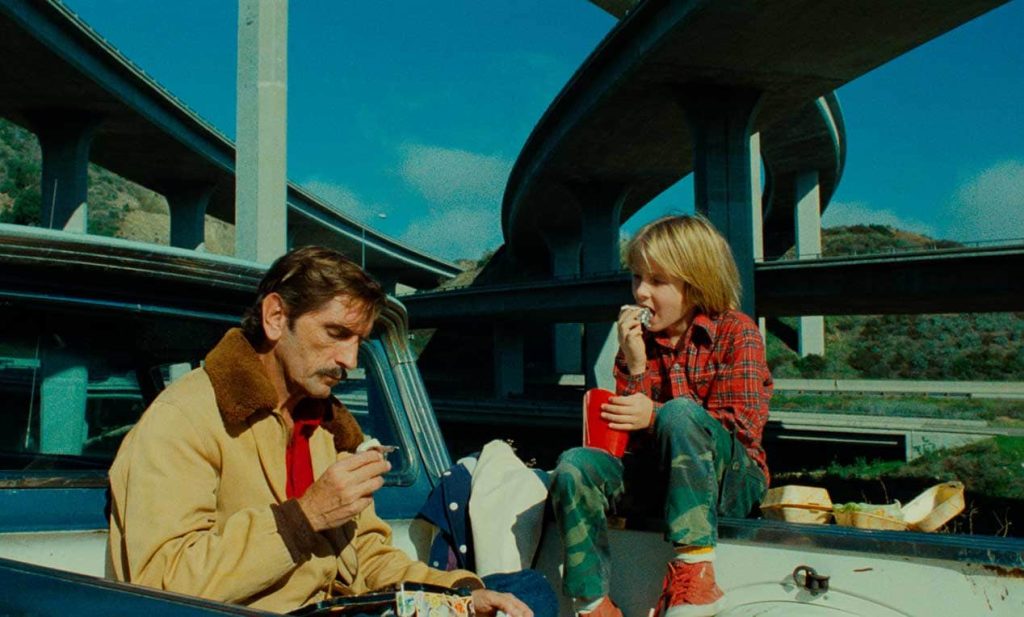
Wim Wenders’ chef d’eouvre, ‘Paris, Texas’ (1984), is a deeply powerful reflection of man. Overcome by loss, guilt, and isolation, our protagonist, Travis (Harry Dean Stanton), must return to an equally dissociated and ever-changing Los Angeles to rediscover his family. As a prominent Euro-American picture, its plot becomes poetry, a protagonist lost in the vast, roseate and unchanging desert; a moving portrait that quickly resembles a Burroughs novel. It is both an ode to a time passed and a love letter to the importance of human interaction in an ever-changing landscape.
Unable to speak, Travis is found by his brother Walt (Dean Stockwell), acclimatised to the life of a lonesome traveller. The following journey to Los Angeles centres around Travis’s learning of the family he left behind. The dimly lit roadside becomes a chiaroscuro painting, in which we witness Travis’s despair firsthand, and learn that his son, Hunter (Hunter Henderson), had been cared for by Walt and his wife, Anne (Aurore Clement). This knowledge becomes central to Travis’s ability to talk with Walt, beginning a plan of action that sees him aim to return Hunter to his mother, Jane (Nastassja Kinski). In a following scene, a home video filmed on a handheld super eight camera, quickly becomes deeply nostalgic for both the audience and Travis. It sets alight his desire to find Jane, who has been living in Houston for much of Hunter’s life.
And so, we see a broken protagonist undergo extensive character growth to bring back the past he had left behind so abruptly. With a score by Ry Cooder, we become witnesses to a romantically optimistic search for Jane. Cooder’s soft, slow guitar strings become intrinsic to the feelings of the protagonists; they become sharpen as the search intensifies and confusion arises when Travis and Hunter follow two identical red cars, one of which is being driven by Jane.
A pivotal scene, centred around our protagonists in a peep show, is enough to reduce any viewer to tears, as Jane and Travis’s separation is mirrored by the partition which isolates them in the booth. Kinski’s portrayal of Jane is both beautiful and key to understanding the plot of the film. Travis’s desire to reunite the family becomes instilled in Jane during this scene, and we, the audience, become mesmerised by the scenes which follow.
A man was once lost, his backed turned to love, as Camus would recognise, must turn his back to love again, and become ‘une petite idée’ (a small idea) to ensure his family’s happiness. It is both an eerie and deeply impactful film that revolves around the juxtaposing geographies of America, and we are left to guess where Travis will go next, as he rides into the sunset on a highway.
It is, without question, the most romantic portrayal of change and isolation; a film that can and should be rewatched over, and over, again.
Image Credit: https://citefilms.com/movie/paris-texas