
by Lara Ziegler, Staff Writer
Human reproduction used to be a short and simple tale. One we have all been told in school: A woman’s egg cell unites with a man’s sperm cell. The chromosomes of the mother and father mix, resulting in a child inheriting half of each parents’ DNA. The fertilised cell grows into an embryo and finally into a new human being. The dream of having offspring that is genetically related to both parents, used to be a strictly heterosexual one.
Scientists have long been rewriting this story. Next to adoption or co-parenting, queer couples nowadays have multiple options to conceive a child. These include donor insemination, surrogacy, or something called in vitro fertilisation (IVF) – a method where egg cells are fertilised with sperm in the laboratory and the resulting embryos are implanted into the uterus of the pregnant person. However, all these options exclude the possibility of both parents being genetically related to their child, as these methods rely on donor gametes – the collective term for egg and sperm cells. It now seems that the rules may be rewritten within the next decade.
A team of researchers from the Oregon Health & Science University have made ground-breaking progress in the field of in vitro gametogenesis (IVG) – the concept of producing human gametes from “scratch” in the lab. For the first time it was possible to turn human skin cells into early-stage embryos.
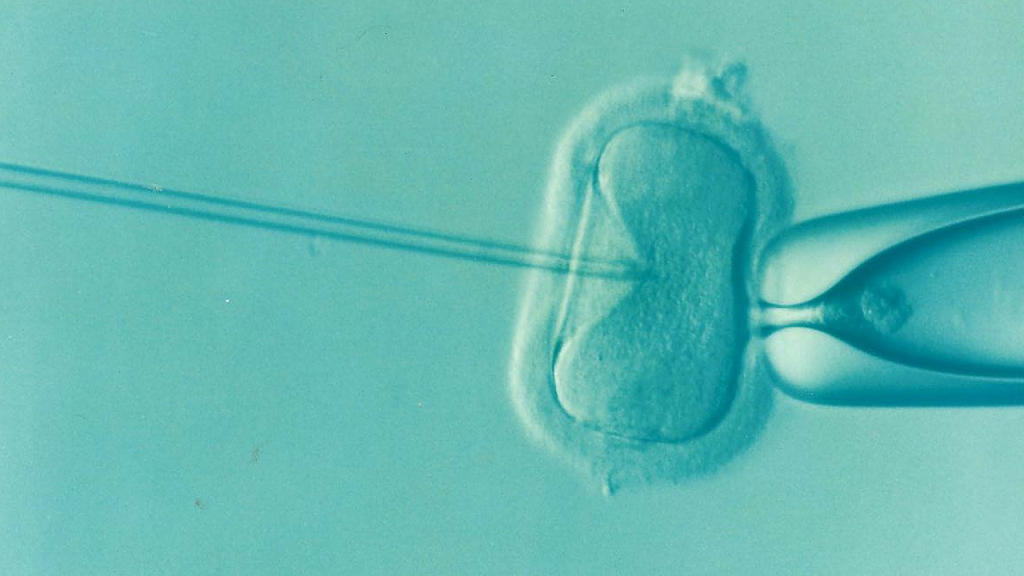
The article, published in the science journal Nature Communications at the end of September, reports on a new mechanism to create a developing embryo through somatic cell nuclear transfer (SCNT). The nucleus of a skin cell, carrying a full copy of a person’s DNA, is taken and transplanted into a donor egg. Said egg has been previously stripped of its genetic information. The upcoming issue now: the cell contains a double set of chromosomes.
For fertilisation however, its genetic information must be reduced to a single set, allowing a sperm to enter and deposit its DNA. This reduction was achieved by a new method the researchers call “mitomeiosis” – a fusion of the cell division mechanisms mitosis and meiosis. While mitosis creates identical body cells for growth, meiosis produces eggs and sperm with only one set of chromosomes.
In mitomeiosis, the egg’s environment forces the new nucleus to divide, pushing half the chromosomes out. After discarding half of its chromosomes, the egg is fertilised and developed to a pre-embryo stage. Since the skin used could come from a person of any gender, this gives hope to same-sex couples. Further refinement of this method might make genetically related children a reality for queer parents.
However, every study comes with its limitations. Early-stage embryos have been developed, but only with a 9% success rate. The chromosomes were discarded randomly during mitomeiosis, not always leaving a sufficient count for healthy development. Also, unlike natural reproduction, this process lacks the mixing and swapping of genes between chromosome pairs — a step called recombination. Without it, the resulting embryos would have less genetic diversity, which could affect their health in ways scientists don’t yet understand. The team stated this study is much rather a proof-of-concept than a fully polished method.
So, how close are we to making this applicable in fertility clinics? Research in IVG is still in quite early stages and further development is needed to ensure safety and efficacy. But substantial progress has already been made throughout the last decade: labs have been able to produce fully fertile offspring in mice from reprogramming bodily cells. These so-called induced pluripotent stem cells (iPSCs) work similarly to our bodies own natural stem cells. They have the ability to be differentiated into a variety of different types, for instance: heart, liver or even brain cells. This has already been demonstrated successfully in many labs. Producing gametes, however, is a very different story and has put many hurdles in front of scientists. While bodily cells develop in the petri dish within a few weeks, for eggs and sperms it can take up to a decade, since they naturally mature only after reaching “puberty” – just like in our bodies. Embryos undergo highly complex development steps that only work in a perfectly curated environment. And cultivating cells in the lab for years increases the risk of something going wrong. Therefore, the process must be sped up and made more efficient, while also being correct – mistakes in development steps are often fatal. Not an easy challenge. Though estimations vary, experts say this might take at least another decade to figure out.
Still, these findings hold immense potential for the future of reproductive medicine. In-depth research may not only lead to successful IVG for queer or infertile couples but also help us to understand the underlying mechanisms of human embryonic development and infertility – thus bringing treatments forward. The demand is high, and researchers are racing to reach the goal, but ethical questions and concerns are being raised at the same time. If we were able to produce gametes in the lab, will this facilitate parents to pick and choose embryos with “desirable” traits? Will this lead to us creating genetically modified “designer babies”?
Although these are not acute issues, recommendations have been already made to the UK government by the Human Fertilisation and Embryology Authority (HFEA) to get ahead on appropriate restrictions. In most countries, human embryo research is tightly regulated and cannot go beyond 14 days of development. Any move toward creating viable embryos from skin cells would require major legal and ethical discussions.
The story of new life may no longer be as simple and restricted as it once was – but we are still far from rewriting it completely. We are still learning how life works and how to harness it. What we do know: it is something to be handled with great care and respect. Current research offers us an outlook into what a future where reproducing is accessible to people of all genders may look like, but for now it remains unwritten.
Image by Elena Kontrogianni via Pixabay