
By Ruby Day, Deputy Editor-in-Chief
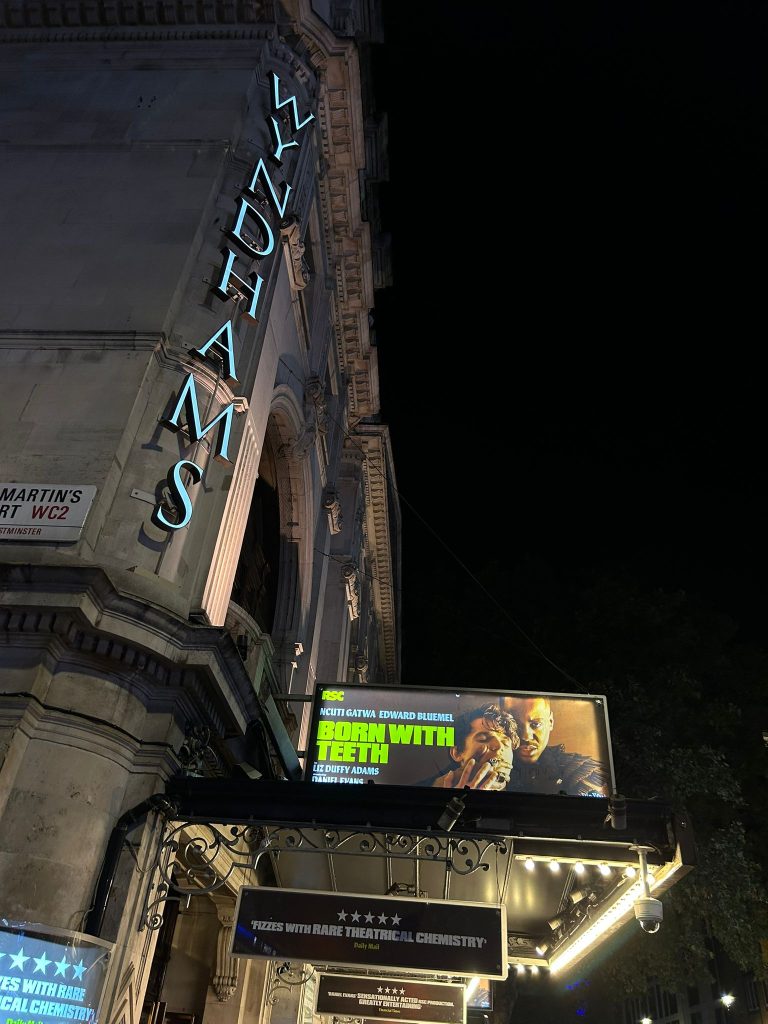
Some experiences are electric. Watching legendary playwrights Christopher ‘Kit’ Marlowe and William Shakespeare prowl around, pine for, and pounce on one another is undeniably worthy of such categorisation. Running for a limited 11-week season on the West End (13th August to 1st November 2025), Liz Duffy Adams’ Born With Teeth combines historical fact, scholarly speculation, and poetic license into an exceptional play that stands testament to the idea that a night at the theatre can be just as educational as attending a lecture.
I admit, I was principally drawn to this production because of the undeniable crush I have on Edward Bluemel, who takes up the role of Shakespeare alongside his forcefully dynamic co-star, Ncuti Gatwa’s Marlowe. Attending the performance was initially an excuse to be in the same room as two rising stars, making provision for future dinner party anecdotes; it also served to bolster my long-neglected affection for Elizabethan England. Entering the play, I thought I knew that Duffy Adams’ writing would play fast and loose with historicity. Exiting the play, I questioned my own certainty of the facts.
Born With Teeth is a remarkably intimate two-hander chamber play, verging on the hyperbolic with its energetic eroticism, and characterised by painful restraint. A tension builds and builds over the three acts, pulled taut but never snapping, and ending so abruptly the audience is left winded by its brutality. Whether the historical Marlowe and Shakespeare were ever truly lovers is rendered unimportant by the play’s wider significance, embodied by this tension; Born With Teeth is a lesson on the importance of art in a censored age, of education dressed up as theatre.
Taking place in the years 1591 to 1593, Born With Teeth sets up Marlowe and Shakespeare in the back room of a pub, collaborating on Henry VI. According to Stephen Alford, this period was the peak of Elizabethan state paranoia, “gripped by existential anxieties and facing an inevitable dynastic extinction” that manifested as vicious treason laws and surveillance techniques. Gatwa’s Marlowe takes as gospel the long-speculated notion that historical Marlowe was involved in this early state espionage. This notion is legitimised by his friendship with Robert Poley, an agent of spymaster Francis Walsingham, who was drinking with the playwright on the day of his untimely death in 1593; subtextual utilisation of minor facts such as this lends didactic weight to the play. The educational aspect is made particularly significant by the extent to which Born With Teeth emphasises Elizabethan state scrutiny and creative policing, making clear that to write a history play like Henry VI was to play a dangerous game. Consequently, a subtle parallel is drawn between the late 16th century and our own time, in which the arts are increasingly defunded and destabilised by governments ignorant of, or afraid of, theatre’s sociopolitical powers.
Regardless of implied political overtones, Born With Teeth also re-centralises the long-maligned figure of Kit Marlowe, aligning with recent discoveries facilitated by data analysis that confirmed Marlowe had a hand in all three of Shakespeare’s Henry VI plays. Marlowe’s name is now featured on the title pages of New Oxford Shakespeare editions of Henry VI, yet another subtextual fact manipulated by Duffy Adams and director Daniel Evans, whose position as the Royal Shakespeare Company’s co-artistic director lends legitimacy to the play’s whole premise. This further clarifies how Born With Teeth, and theatre generally, can illuminate truth via escapism, making a strong case for why education and the arts are not mutually exclusive.
Engaging with the arts critically and receptively allows movement between sectors, providing fluent commentary that can be ignored in favour of superficial enjoyment, or investigated in favour of personal or social enrichment. Even at Royal Holloway, with upcoming productions like Shakespeare Society’s performance of Rosencrantz and Guildenstern Are Dead, it’s possible to engage with this concept.
Born With Teeth proved that, in watching Marlowe and Shakespeare fight and flirt like their lives depended on it, important lessons can be learned, warning against adhering to the erosion of the art world by the powers that be.
Image by Ruby Day