
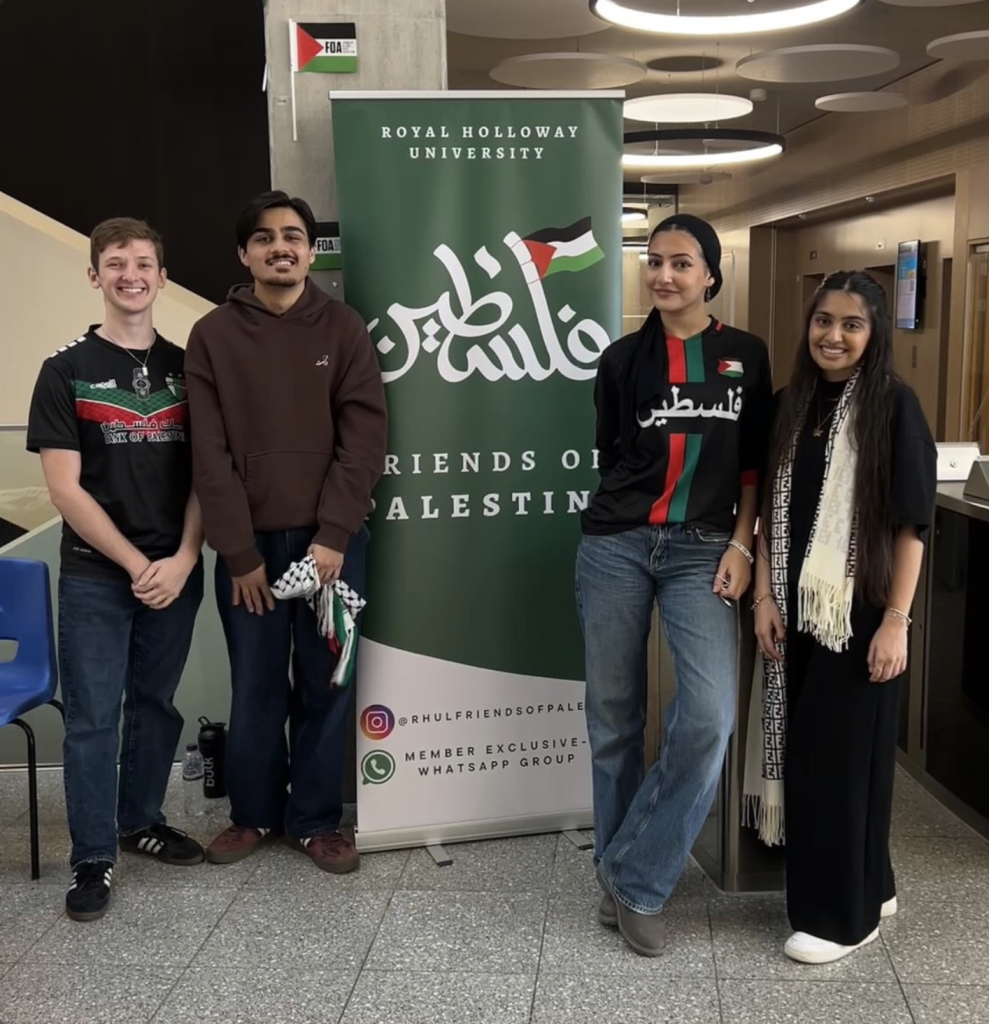
By Madeline Sidgwick, Senior News Editor
In September I had the opportunity to interview Huda and Noah, the President and Secretary of Friends of Palestine society here at Royal Holloway for the 2025-2026 academic year. Upon preparing for this interview I wanted to reveal the practicalities of becoming a ratified SU society as well as the challenges that specifically activist related campus groups face. In a productive and inspiring conversation, Huda and Noah were transparent in the struggles they face on campus and emphasised the undeniable importance that students get involved in campus activism.
How did you find the process of organising ‘Friends of Palestine’?
The origins of the society are in Arab Society. Huda described to me the process of becoming a ratified society as simple in theory, but often quite lengthy in actuality. The requirements of the Student’s Union (SU) are as simple as having three committee members, but when being perceived as possibly ‘controversial’ the process became longer than the original committee anticipated.
What kind of struggles did you face in your first year being SU ratified?
“Finding a space to exist within on campus”. Navigating how the committee wanted to be perceived and placed into what category was one of the first challenges in starting a new student group. Deciding whether the society would be cultural, educational or religious was a challenge, especially as ‘Friends of Palestine’ could very comfortably fit into all of these categories. Huda and Noah emphasised how the primary goal in creating the society was to ensure that “Palestine is not just known for war”. Therefore, it naturally played out that the society would be a hybrid of all elements and secular, to ensure inclusivity and a focus on Palestine outside of the context of the ongoing conflict. To ensure this, the society promotes the religious celebrations of all abrahamic religions, to ensure those of all religious backgrounds feel as if they have a place within this student community.
Do you feel as if there is an additional pressure that comes along with being an ‘activist’ society?
Huda explained how students often have unrealistic expectations of the society’s influence. For example, the Starbucks that was formerly in the library or the SU’s partnership with Domino’s. It is key to remember that although brilliant at fundraisers and raising awareness, the society is still a student led group and not a large corporation with financial power or president. Huda and Noah both articulated how the committee picks its battles carefully. The risk of being perceived as aggressive, standoffish or unwelcoming is not worth it when an argument with a more powerful body is going to be redundant. The society focuses extreme efforts on being welcoming and the idea of alienating anyone over a pointless battle would do all parties more harm than good.
Both emphasised the importance of membership. More members equals more SU attention and recognition. Thus, the best thing students can do if they wish to have their concerns regarding Palestine heard by the wider university, is to purchase a membership via the SU website. It was also emphasised that students must be educated on their rights and stand on business when it comes to issues that they believe in, whether this be in regard to Palestine or not. The issue of fear mongouring around the topic of Palestine is rife within the UK, specifically on university campuses. The society urges students to be educated and know their rights, as well as what they can and cannot say in the current political climate. Such education can ensure that wrongful accusations do not occur at the hands of more powerful bodies. “Many are too willing to point fingers before educating themselves”, explained Huda, making educating yourself more important than ever.
Do you face any misjudgement of the society at the hands of national headlines?
The short answer is “yes”. There exists a preconceived perception that the society is filled with argumentative activists. Both Huda and Noah raised how the society works tirelessly to prove otherwise and both recognised that if you are on the side of any political cause that this is often the case. The society is constantly working to show that they exist on campus for love and education.
What advice would you give to someone who wants to support the Palestinian cause or get involved with
the society, but may feel scared or overwhelmed to do so?
Huda answered by stating “no one is going to be a good activist, or get good at activism unless they try it, it’s the same as maths”. Friends of Palestine Society is a welcoming space that allows all to get involved in any degree they would like, acting as a safe space to allow yourself to become an activist. The key is to show up for causes that you believe in and “you don’t have to be the loudest in the room”. No one fits into a binary when it comes to activism, so try out the spaces that represent your beliefs and perhaps you can find your own way to best support what you believe in.
Noah placed emphasis on “what will your grandchildren think?”. He highlighted what future generations may think of us when we are gone, and how he doesn’t want to be remembered as not supporting and standing for the causes he believed in. Both also emphasised how being an activist is not simply sharing AI generated images of Gaza on your instagram story. It’s about speaking up and attending fundraisers and events, like the society offers. It was also discussed that if you are scared to believe in or stand up for something, then perhaps ask yourself why. If this reason is negative then work on this, reflect on your own prejudices and become a better person that is clearer on what they believe in, and for what reasons. “It is never too late to learn and get involved in something you believe in”.
What role do you think student movements and student activism play in global solidarity movements?
Both Huda and Noah answered my question in two parts, the role of student activism on campus and its role globally. In regard to campus it is all about education. It is important to the society to emphasise that Palestine is a nation, and not simply a trend that makes you look progressive. Noah referred to the fact that Royal Holloway and Bedford College was once a women’s only college. What would the women who attended Bedford College think of students if they were not standing for the causes that they believe in? As a part of the Global Solidarity movement, both believe in the power of students and the role that students have historically played when being “on the right side of history”. Both Huda and Noah also explained their personal connections to Palestine and how their Palestinian heritage provides a sense of personal duty for them both. Their overall message was clear in that their activism is to prove that everyone is a human being, and that separation and segregation creates toxic binaries that as privileged students, we should aim to break down.
I want to thank both Huda and Noah for taking the time to have such a productive conversation with me. Friends of Palestine memberships can be found on the SU website. All membership costs go into the fundraisers that the society hosts, and all profits are then donated to charity. If you are a student that believes in the Palestine movement, or any movement for that matter, in any capacity, get involved and have your voice heard and think about what your grandchildren will think when they read about our generation in the history books.
Follow Royal Holloway Friends of Palestine on Instagram for all of their information and upcoming
events. @rhulfriendsofpalestine
Photo Credit: Royal Holloway Friends of Palestine