
By Suhana Limbu, Associate Culture Editor
When I began planning this article, I asked my British-Nepalese peers a simple question: “What do you think of when I say ‘literature’?” They answered profusely. They recited writers, novels, and poems, but they were all Western-centred. Once I asked what comes to mind when I say “Nepalese literature”, I was met with a pause. After a moment of struggle, they admitted to their limited knowledge; many of their answers connoted ideas of ancient folklore, religion, and lost literature.
The phrase “lost literature” particularly gripped me. In recent years, there’s been a clear rising interest in Asian culture. Although seeing this representation heartens me, I’ve noticed that there’s no presence of Nepalese literature––how have we come to “lose” it?
I decided to ask my parents what they thought about Nepalese literature. Born in the 1970s, they’ve seen many versions of Nepal, yet their knowledge of its literature was also sparse. However, while my restricted knowledge and my peers’ is caused by the overshadowing privilege of British education, my parents are restricted by a neglected education system. Nonetheless, they both shared one idea: Nepalese literature examines how identity has been profoundly shaped by the country’s history, culture, and politics.
I began to look into the development of modern Nepalese literature. Throughout the nineteenth century, the British’s recruitment of Nepalese soldiers into their Indian armies, alongside a collective desire for opportunity, caused an increase in migration to India. Therefore, any Nepalese-language intellectual activity was displaced into cities in India. It’s these moments in history that can connect the deprivations of Nepal’s poor economic prospects and political instability, to the halted development of a premature, modern Nepalese literature. This causality birthed fear of the country losing its identity.
However, this fear sparked a literary movement during the 1920s and 1930s, formed by groups of high-caste, male Nepalese intellectuals living in Indian cities. They retaliated against literary elitism which valued only classical Sanskrit forms and the stigma that Nepalese language is a low-class vernacular. Amidst this disparity, Nepal had also subjected itself to a prejudicial caste system since the 14th century. Nepalese intellectuals were concerned with this amalgamation of division, and aimed to shape literary forms into a vessel through which jāti (a direct translation to ‘type’, referring to one’s birth-caste) could be carried into a single national identity.
One of the earliest works, which adopted this idea of jāti, is Laxmi Prasad Devkota’s 1936 poem, Munā Madan. In this episodic tragedy, we follow two lovers, Madan, who ventures to Lhasa in search of fortune, while Muna succumbs fatally to her broken heart. Written in Nepalese colloquial vernacular (the Jhyāure poetic meter), Devkota proudly subverts the classical Sanskrit form. It’s also where he writes the famed line, “मनिस ठुलो दिले हुन्छ, जातले हुँदैन ।” –– ‘A man’s greatness is determined by his heart, not by his caste’.
Nepal’s literary culture had been reborn into a movement against social and political injustices. Devkota’s critique of the caste system is only one of many. In modern times, Nepalese literature has expanded beyond the elite, and everyday voices are able to express their honest pessimism and marginalisation caused by Nepal’s lacking prospects. My father also felt this shift. He recalled experiencing caste discrimination as a child, and witnessed the system’s abolishment in 1963. He also remembered how, during the 1990s, many Nepalese writers were censored from criticising their then-monarchy.
My parents came of age as their country transitioned from a monarchy, enduring a decade-long civil war and the 2001 Royal Massacre, before its establishment as a Federal Democratic Republic. And, most recently, they’ve witnessed a national upheaval: Nepal’s ‘Gen Z’ protests. For them, Nepalese literature isn’t frozen in an ancient past; rather, it is a constantly transforming current that swims through the country’s political history they’ve lived. It has a purpose, and it’s rich.
During this process, I had to admit to my own ignorance and dissect the complexities within my British-Nepalese identity. Because of this, the final question I asked my father was if he felt disappointed that I didn’t have a connection to Nepalese literature when, in its place, I’m pursuing an English literature degree.
He answered with a firmness absent in previous questions: “Never”.
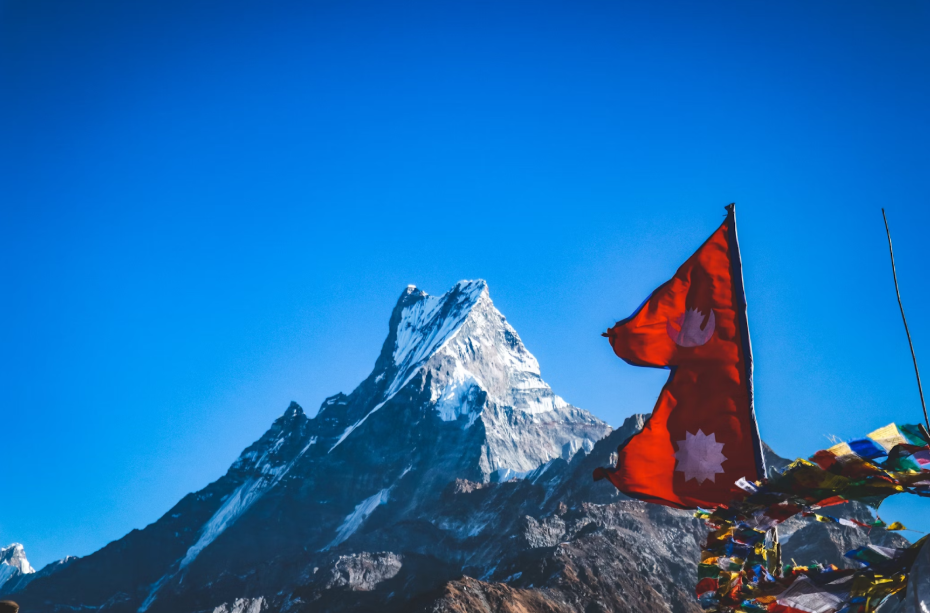
Image via Samrat Khadka on Unsplash