Ruby Saggers, Editor-in-Chief
Content Warning: Mentions of cancer, bereavement, and bullying
Being Editor-in-Chief during our forty year celebration of The Orbital is certainly a recognised privilege. This landmark has elicited particularly heavy reflection in myself, on top of the dread I already feel in my final teaching term as an undergraduate. My biggest reflection, however, is on how doubtful my seniors had always been of me – and how I have subsequently managed to prove them wrong. I hope that this piece gives you inspiration, working-class or not, to keep pushing regardless of outside opinions and assumptions based on the life handed to you.
At birth, much of my life had already been set in stone. My father, once a hardworking scaffolder, had been diagnosed with a brain tumour in 2005. As soon as my little brain understood my dad was ill, I became a young carer. At every stage in my childhood education, teachers recognised me as ‘the one with the ill father’, and thus I was treated as such. I received maths tutoring in primary school without being asked whether it was needed – I was doing perfectly fine, and in fact always achieved the same results as my peers. I had counselling that never helped, only made me think that it was all in my head – ‘thoughts create feelings’, they would tell me. At the end of year 6, my peers all headed off to their top choice secondary schools. For reasons unbeknownst to me (I can make an educated guess, however, that this is also part of the judgement I had been susceptible to), I was given my bottom choice and had to fight through appeals to end up where I did – an all girls school that I desperately wanted to attend.
Secondary school welcomed many new challenges into my life. I was bullied from the moment I got there, and I never quite understood why. Unfortunately, much of the verbal side had been in reference to my dad’s health, my council house, and my upbringing as a child on benefits. My mum has always worked tirelessly to provide for me and my siblings, and continues to do so today. I could never comprehend why people would pick at my family’s financial difficulties, when she had always worked so hard to keep a roof over our heads – to me this was admirable, not humorous. Whilst moving through the school years and facing my GCSE’s, Covid-19 struck and I was one of the first to quarantine in order to protect my dad. Still, I sat every exam and made it to Sixth Form.
Sixth Form proved to be the most difficult in more ways than one. My first year went perfectly, almost too perfect given how everything had been until that point. I was achieving A’s and A*’s, and knew exactly where my life was headed – I wanted to apply to Cambridge. This dream, however, was quickly crushed after a teacher told me “people like you don’t typically get in”.
People like me. An assumption that follows me everywhere.
A young carer, a working-class girl, Cambridge?
As many will now know, having frequently written about him in the Creative Writing section of The Orbital, I lost my brother on the last day of year 12 very suddenly. He was reported missing on 19th July 2022, and found on 21st July 2022 at 8:30pm. Seeing your brother’s name plastered onto news articles like that is not something you’d ever think would happen to your family – until it does.
I returned to school in September, having laid him to rest just a few weeks prior, and felt determined to finish my A Levels in his honour. Teachers questioned my being there, believing that I should have taken a year out to grieve. Instead, I pushed through my exams deep in grief and ended up at Royal Holloway – an institution I was more than pleased to get into.
Now, I am in my final year, and life has not been much kinder to me. I lost two cousins to cancer, two grandparents three months apart, and my father is now in palliative care with a second tumour in his brain.
Many would question why on earth I would put myself through balancing an English degree and running a student magazine at the same time as dealing with constant grief and the fear that every time I return to university after a break could be the last time I see my dad. Honestly, I question it too.
Dealing with constant judgement simply because I have grown up unprivileged, unfortunate, and surrounded by ill-health is precisely what feeds my determination. From the moment I started university, I have wanted to prove people wrong. This university, and indeed this magazine, doesn’t see me as any less than my peers for growing up with different circumstances. In fact, I have been able to explore and celebrate these differences through the writing and editing you see today.
At present, I write to you as someone that is edging closer to finishing her undergraduate degree and starting an MA in Medieval Studies at King’s College London. I write to you as someone whose father, despite having been given a 3-6 month prognosis in September 2024, is still here. I write to you as someone who hasn’t had the same opportunities as many others have had, but have still ended up on the same path.
My point to this article isn’t to just relay my life to The Orbital readers but to show that no matter what life throws your way, anything really is possible. I could have given up, and I truly wanted to in every stage of my academic life. But I didn’t, and I really hope anybody else in a similar position to me chooses to keep pushing too. Of course, take breaks and remember to breathe – mental health will always be far more important than your education. But absolutely strive to break boundaries, prove people wrong, and fight against those that wish to pull you down.
This has been written in honour of my beloved brother, who passed away at 24 years old, and my incredibly strong father who, despite his memory and understanding often betraying him, I will continue to try my absolute hardest to make proud.
This is also in recognition of every working-class student that continues to defy expectations simply by showing up, achieving their dreams, and going on to lead successful lives – whatever successful may mean to them.
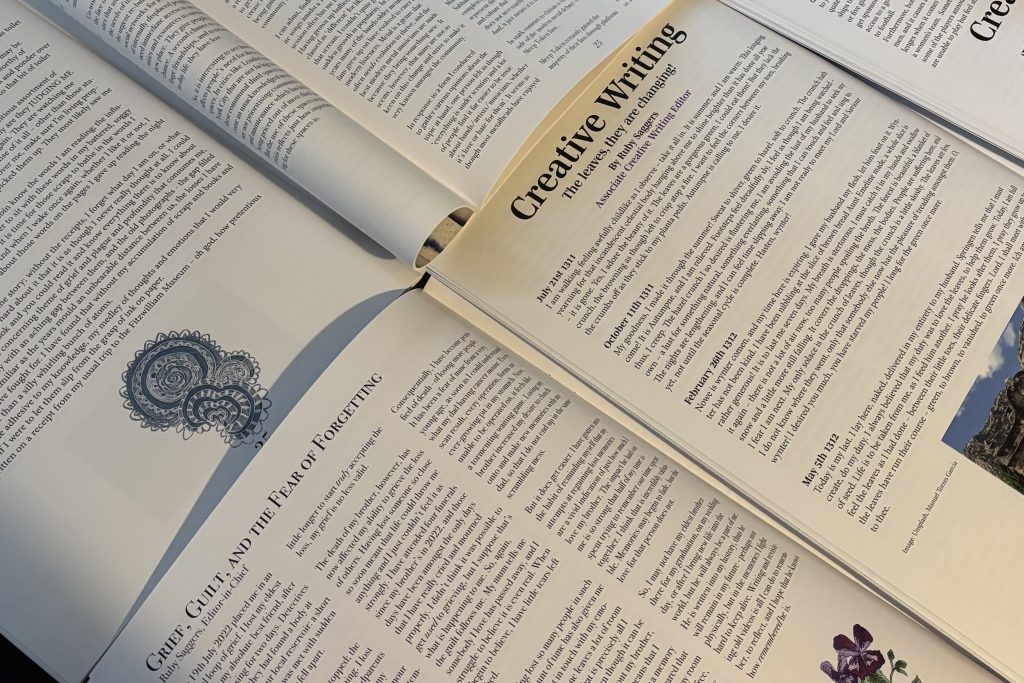
Image taken by author