
Nia Videnova, Staff Writer
Traveling has become an intrinsic part of the way we enjoy our free time. Border relaxations, savings from the Covid pandemic, and mind-blowingly cheap flight apps have converted travelling into everyone’s hobby, dream, and entertainment. Nowadays, it is hard to find someone who doesn’t have the goal of “traveling around the world” on their personal agenda. The quality of our camera is not satisfying anymore when it comes to producing a unique selfie in front of the Eiffel tower – simply because everyone has taken a selfie like that! What is challenging, however, is for us to realise how detrimental our common traveling interest could be. We, as innocent tourists, are responsible for 8% of the global emissions, the rise of prices in normal cities for normal people such as in Paris and Barcelona, and the lack of access to basic resources such as water in places like Kenya. Pleasure and entertainment that have been positively associated with exploration, cultural development, and historical enrichment have transformed themselves into something more threatening and controversial.
This article is certainly not aiming to take away your holiday plan for next summer or claim that I, myself, follow religiously the principles of non-traveling. Exploring the world is, indeed, a beautiful and enriching activity. However, the repercussions of traveling excessively could help us recognise how watching a football match in the stadium in Barcelona rather than from home is a luxury and not a necessity.
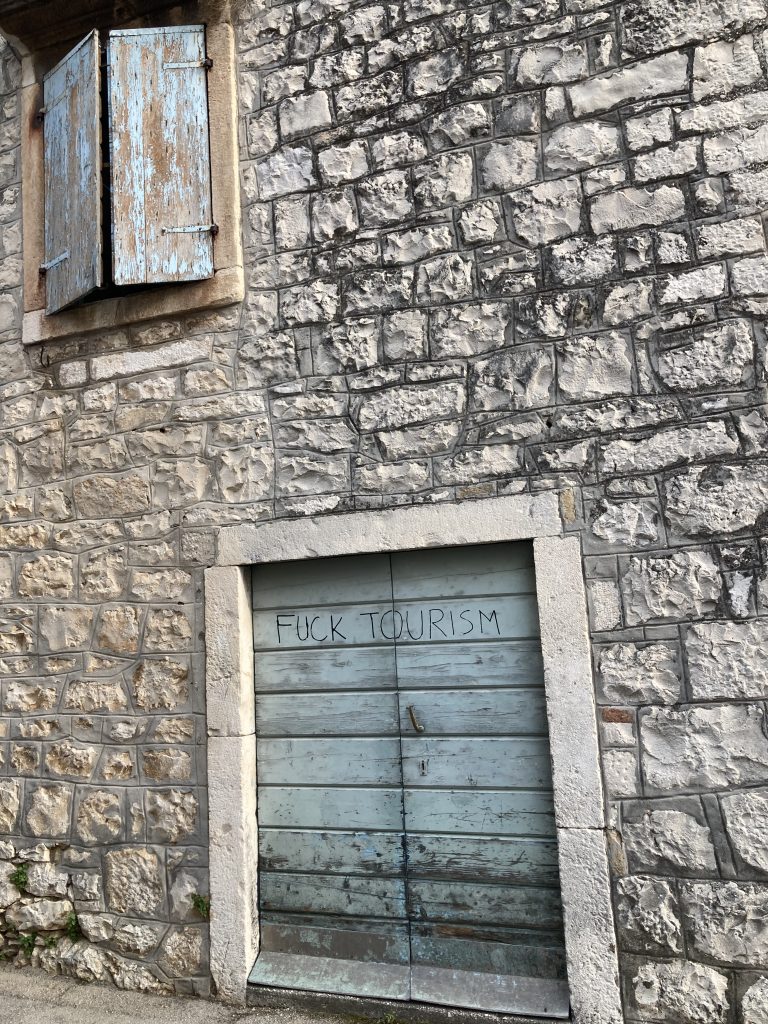
Many of us are most likely familiar with the protests in Spain over tourism that took place in popular destinations such as Barcelona, Palma de Mallorca, and the Canary Islands last year. These places, famous for their cultural wealth and environmental lavishness, have sadly lost their authenticity due to the act of touristification – a process under which a place changes to appeal to tourists and cater their needs rather than the needs of its permanent inhabitants. For Spain, this has led to the prioritisation of tourists when it comes to accommodation forcing Spanish people out of their properties, making it more difficult for them to purchase one, or even making them sleep in their cars in some instances. Prices in these regions have skyrocketed to take advantage of tourists, while sacrificing the workers living there. Cuisine has been altered to appeal to the international taste favouring pizza, pasta, and burgers. Overcrowding has made daily moving and transportation way more challenging for local people. Some tourists have displayed loud and disruptive behaviour as well as played a substantial role in the contamination of beaches. Looking at tourism from this perspective is definitely more helpful to understand the frustration these people have been experiencing.
Unfortunately, using the argument that tourism is good for the economy of the country is insufficient to justify our guilty pleasure. Most of the workers in the tourism and hospitality industry receive minimum wage and their working conditions are not the most favourable. Think about hotels in exotic destinations such as Bali or Cancun! Some of these buildings are constructed in isolated areas that are difficult to reach for working-class people, who have no car and public transportation in those areas is scarce. The excess of luxurious hotels in many holiday islands have contributed to water and electricity shortages for local people taking away their basic rights while prioritising the tourist. This is not sustainable economic growth, nor a fair way to use landscapes.
Another factor we should keep in mind is how the charm of these holiday destinations has been lost. We, as tourists, claim to be deeply intrigued by foreign culture, history, and landscapes, while failing to appreciate it. It feels like if I had been blindly dropped into the high streets of Rome, Nice, Split, Vienna, Berlin, or Barcelona, I would not be able to tell the difference. The distinctly cultural place we wanted to visit ended up being quite similar to the previous one thanks to the constant presence of large chains and multi-national corporations such as Adidas, Zara, and McDonalds. If I wanted a Pandora moment of the Eiffel Tower, would I really need to go to Paris to grab one? Would that be the main reason for my visit to France? Did I come to France to have McDonalds? Am I going to drop by Zara to have a look at the sale? Am I going to end up buying Lindt from Vienna as a present for my boyfriend as if I could not get it from my local Tesco? I went to Rome, but I can’t speak a word in Italian? And finally, not to forget the duty-free perfumes at the airport on the way back! These franchises and the habits we have adopted have destroyed the real value of the cultural places we visit. Even if we claim to make the most out of sight-seeing, museums, and tasting local cuisine, we tend to sight-see the Americanised culture that has overtaken many touristic areas.
Selfie culture is another sad motivation that has driven many of us into excessive traveling. We have all seen many of our friends posting a selfie in front of the Eiffel tower, on a Venice bridge, next to New York skyscrapers, or with the breath-taking view of Mount Fuji. Strikingly enough, some people wait in a queue for hours to take the perfect selfie on one of Venice’s most famous bridges. Sacrificing so much of our time abroad suggests that we are more concerned about our image online and proving we’re having fun, rather than enjoying the moment!
Traveling should be a mindful and considerate act of recreation and should not happen at the cost of other’s lives, cultures, and natural habitat. Consider putting in practice some of these suggestions on your next holiday trip:
1. Ask yourself how many times you have travelled this year and if you really need to go abroad on every holiday! Remember, traveling is a luxury and not a necessity!
2. Consider going somewhere closer or to a place that doesn’t involve flying! You can surely relax in many lovely places other than the Maldives.
3. Go to a place that is not so popular for tourism! There are thousands of beautiful destinations around the world that have simply been underrated.
4. Travel when your desired destination is not too busy!
5. When visiting, be mindful that you are a guest and don’t disrupt the locals!
6. Don’t get swayed away by popular brands when being abroad! You probably didn’t go to Barcelona for new Nikes.
7. No need of selfies of everything and everywhere! Just enjoy the moment!
Excessive tourism proves to have repercussions not only on our bank accounts, but also on the local people living there, the authentic culture in those places, and the environment. This is not to say that we should drastically stop traveling and stay in the same place! Try to follow some of those tips so your next travel is a more conscious and sustainable choice. Aim to conserve the beauty of your favourite destinations!