By Claudia Beal, Staff Writer
In December 2025, the battle for ownership of Warner Bros Discovery ‘ended’ in a £61 billion deal from Netflix. However, on February 27th, Netflix walked away from the deal. Paramount Skydance is set to take over Warner Bros. Discovery, having won its hostile takeover bid.
In December, Paramount, despite the larger bid, seemed the smaller player. Netflix had almost conclusively won. The deal would have made the new conglomerate a giant in the entertainment landscape, which raised concerns of anti-competitive behaviour and awaits approval by associated authorities. The Writers Guild of America commented that the former Netflix merger “would eliminate jobs, push down wages, worsen conditions for all entertainment workers, raise prices for consumers, and reduce the volume and diversity of content for all viewers.” Additionally, concerns had been raised as to whether or not new Warner releases would not be shown in theatres due to Netflix’s preferred streaming model.
Netflix was not concerned, declaring “full speed ahead.” However, Netflix’s competitor for Warner, Paramount Skydance, announced another bid for the company in response. Paramount has pushed its bid ever since, garnering favour while Netflix’s confidence slipped.
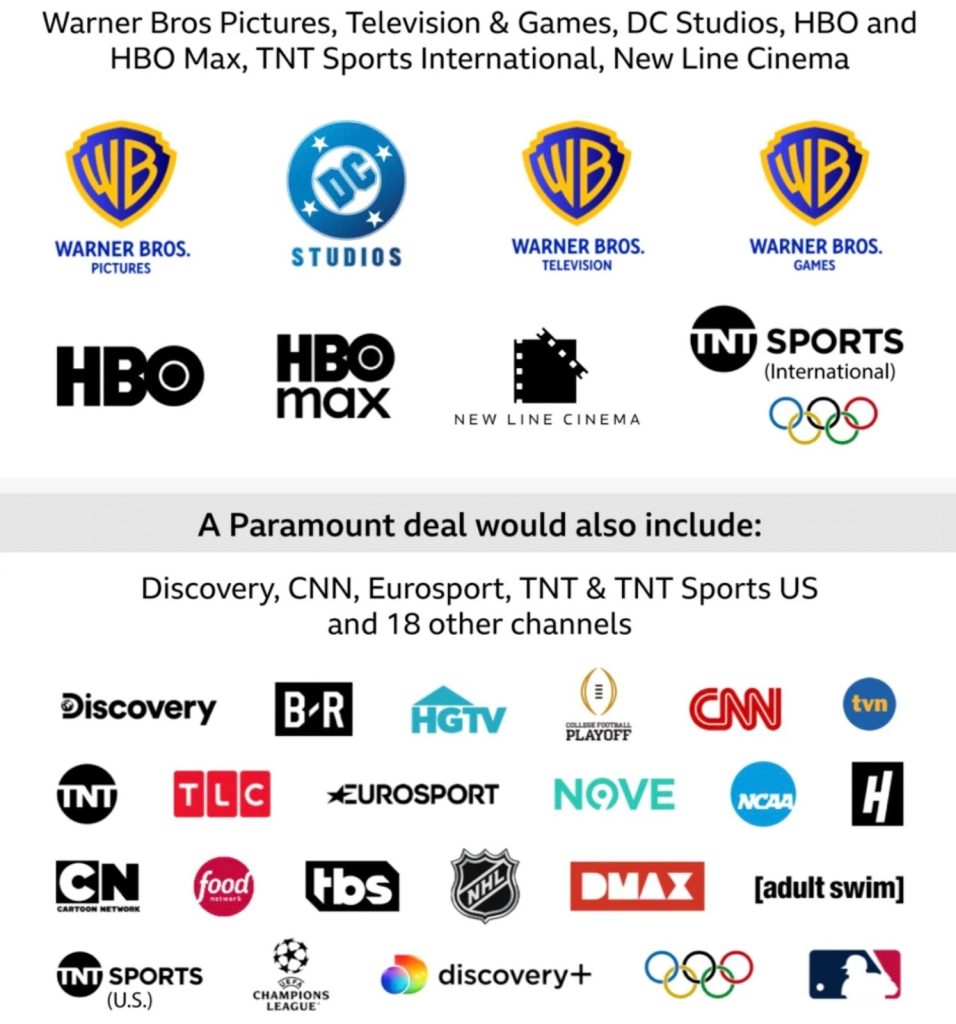
Netflix, the streaming pioneer, is still the largest in its field, but has been steadily losing popularity and subscribers. Many see its motivation to purchase Warner as a purchase of their library, not their production. The deal would have meant that Netflix would secure a vast collection of content as well as the production studio. This includes Harry Potter, the DCU, Lord of the Rings, The Matrix, and all your HBO shows. This content now belongs to Paramount.
A frequent consumer concern was how films would be released; would they go to cinemas or end up on Netflix instead? This would bring about a situation similar to that of Knives Out: Glass Onion, which only spent a month in theatres before being placed on Netflix, and Knives Out: Wake Up Dead Man, which spent less than a month in theatres. Another concern is that this method of distribution critically damages already-declining DVD sales. DVD sales, like television reruns, are a stable source of income for union industry workers in the form of residual cheques. Streaming, however, has come under fire in the last few years for not providing residuals, and instead pays workers on a ‘lump-sum’ basis, making it hard for many to make money in between projects.
Despite Netflix’s confidence that the possible backlash they would face from anti-trust lawmakers would be minimal, their senate hearing in the US was rocky at best. Some Republican senators focused on criticising Netflix as a platform of ‘wokeness,’ while others made more founded claims on the jobs potentially lost and the monopolisation of both the audience and of opportunities for workers. Netflix was prepared to fight the claims, but now they won’t have to. Paramount’s takeover is expected to be debated on the topic of anti-trust laws, but many of the Republican lawmakers who raised concerns over Netflix are now backing down for Paramount.
The reason for Republican’s favour towards Paramount has been linked towards what it is the company is actually trying to buy. Speculation turns towards the other properties that Warner owns. Paramount asked for a complete buy-out of all Warner properties, including the Discovery Channel, CNN, Cartoon Network, Adult Swim, and several sports networks. In contrast, Netflix didn’t want to purchase these properties and would have allowed them to form a separate company after the merger.
Paramount has been criticised for its attempt to acquire CNN in particular, considered to be the United States’ mainstream left–leaning and independent-favoured network. Concern comes in light of Paramount’s ownership by the billionaire Ellison family. Larry Ellison, who has personally fronted up a £40.4 billion guarantee on the over £80 billion Paramount offer, is a major donor to current US president Donald Trump.
Until recently, Trump stated that he would be ‘personally involved’ in reviewing the Netflix merger, and declared a preference for Paramount after it announced the £80 billion counter-offer. Now, despite meeting frequently with David Ellison (Paramount CEO and son of Larry Ellison), Trump claims “I haven’t been involved.”
Additionally, Paramount’s offer is partially funded by Affinity Partners, a private equity firm owned by Jared Kushner, Trump’s son-in-law. Affinity Partners is composed primarily of funds by the Public Investment Fund of Saudi Arabia’s monarchy. Along with Kushner’s two other funders, Qatar’s QIA, and UAE’s Lunate, the three nations comprise 99% of his funding, and are all separately involved with funding the Paramount deal.
The heavily political details behind Paramount’s win have taken centre-stage in public debate. Paramount has promised to pay any fees related to a cancellation of the Netflix deal, and $650 million USD to each major Warner shareholder for each quarter that the Netflix deal stalls until 2027. Its strategy was to wait out Netflix as it gradually replaced members of the WBD board. However, success has come sooner than expected, with Netflix refusing to raise their offer above Paramount’s.
There are no comments from Paramount yet as to the cost of a new Paramount+/HBO Max platform, or as to how it will go about a subscription service. The two platforms are expected to merge, forming a more competitive service that could rival Netflix, Disney+, or Prime Video. The increased price of this service is expected, at least, to be cheaper than Netflix, which researcher Ben Barringer refers to as the ‘price-setter in the market.’ While HBO Max has previously not been available in the UK, it will be as of March 2026.
Fears over a Paramount takeover concern political interference, along with claims that Paramount’s debt is too large and that the new company would be unable to financially recover. While Trump has spoken less and less about the former Netflix deal, his supporters in MAGA have frequently been critical, and will likely celebrate Paramount’s win.
The outcome is, centrally, a great loss for those in the industry, and for the creative identity and individuality of Warner Bros.
Image by Thibault Penin: Unsplash