
By Liv Briens Montero, Staff Writer
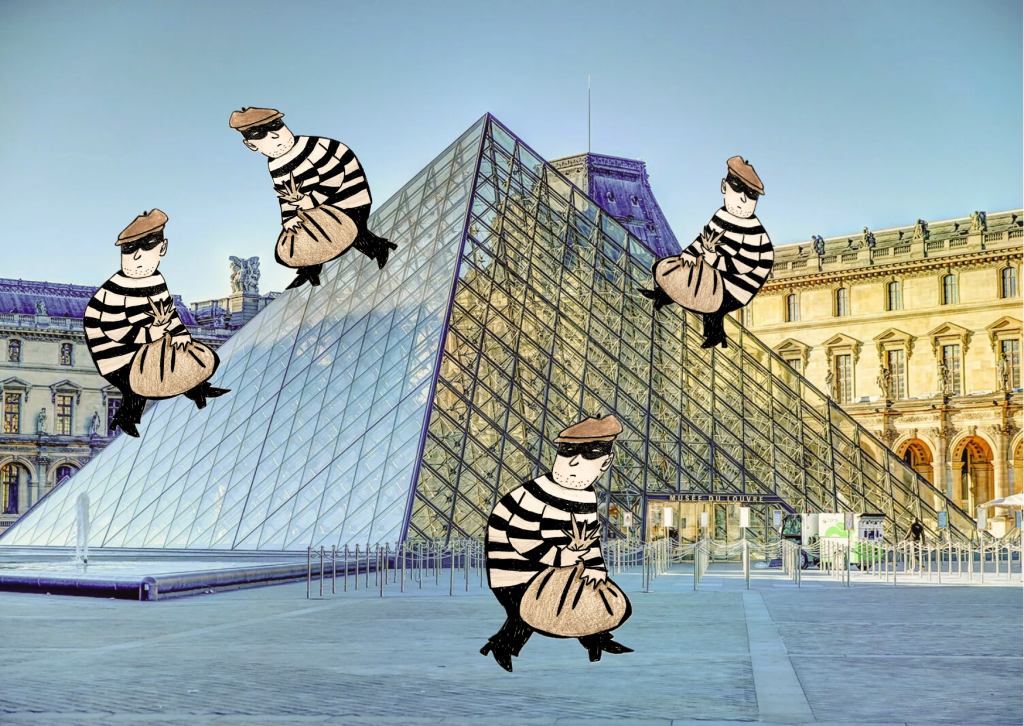
On the 19th of October, Sunday morning in Paris, the world’s most visited museum became a stage for an old fashioned heist. It truly sounds like something out of a mystery novel: a handful of men dressed as workers, a crane and a broken window- and the Louvre, the holy grail of French culture and history, robbed in broad daylight. In the age of elaborate technology, such as facial recognition and AI-driven surveillance, the burglars did not need high tech hackers or tools. They simply climbed, cut and left on their scooters.
The world watched in disbelief. How could the most frequented museum on Earth, home to some of the most famous paintings, as well as the very symbols of France’s grandeur, be humiliated by an operation so simple it bordered on absurdity? The heist, a few minutes of movement, revealed not only the fragility of the windows and glass displays of the Louvre, but the fragility of institutions we deemed immovable.
Choreography of A Perfect Crime:
At around 9:30am, right after the museum opened for visitors, four suspects began their well rehearsed choreography. They broke into the Apollo Gallery, situated on the Seine facing part of the museum, using a mechanical lift parked outside. As if straight out of a spy movie, the thieves used power tools to break the window, and cut through the glass of two displayed cases containing valuable jewelry from the Second Empire. According to the authorities, eight items were taken including diadems, necklaces, earrings and brooches. Overall, the thieves’ clever “dance” inside the largest museum in the world lasted four minutes, but disturbed centuries of stillness.
But was it genius on their part, or a weakness of the museum’s security? French media reported that one of the three rooms the thieves broke into had no CCTV cameras. The suspects threatened the security guards with their power tools, and were able to leave effortlessly on their motorbike with the stolen goods. Which begs the question, if France neglects to safeguard its cultural heritage, and national treasures, what else will it fail to protect?
France in Motion:
France, already weakened under the weight of social unrest, and political tension, suffered a symbolic blow. How can the nation feel protected if France struggles to preserve its most important cultural partimony? The sense of stability that an institution such as the Louvre provides, a stillness, a sense of safety, now feels unsteady. The stolen jewels are not only objects, they reflect on the authority supposed to safeguard them. In a climate where citizens are already questioning the system and its credibility, this robbery proved the widening gap between image and reality in France’s institutions.
If the Louvre can be violated so easily, what does that say about other institutions we trust implicitly? Are governments, banks and archives any less vulnerable than a glass case?
The Absurd Elegance of Simplicity:
There is irony in the simplicity of it all. In a world where cyberattacks, high tech drones, and AI espionage are seen as the main threat, the museum fell to an old fashioned plan, showing that sometimes, brazenly simple works best. The robbers didn’t need to outsmart algorithms, they only had to exploit complacency. The irony is almost poetic: a global powerhouse of art and culture, surrounded by technology and prestige, undone by a simple movement.
Ripple Effect of One Swift Movement:
The movement of a few jewels created an international uproar. One act of motion, from a display case to the perpetrator’s pockets, showed the fragility of the museum, once a symbol of permanence. Their disappearance became a metaphor of power itself. What seemed untouchable before is now revealed to be painfully vulnerable. This exposes a truth that cannot be ignored: even the strongest institutions can be undone by the simplest movement.
Illustrations by Lucy Griffiths, Head illustrator. Photograph by ©Torval Mork/stock.adobe.com