
By Lily Gregory, Senior Agony Aunt
In the last academic year (2024/25), many news outlets reported the declining situations of many universities’ financial problems. This issue could be found in many universities across the UK, and it appeared to impact the Classics community the most. In 2024, it was reported that the University of Roehampton had shut down their Classics Department, and Cardiff University would no longer run its course called “Archaeology and Ancient History” from 2026. For Classics and other Humanities Departments, things were not looking good.
As a current Master of Arts student in Ancient History (and a Bachelor of Arts student in Classical Studies from 2021 to 2025), this was deeply worrying for me; the subject I loved seemed to be under threat. Rumours began to spread that the Classics Department at Royal Holloway, University of London would be shut within ten years if things didn’t change.
Of course, this was just a rumour. When looking at wider statistics concerning Classics lecturers and students in many of the UK’s universities, it is clear that closure is a lot less likely than I first thought. In 2023-24, the Council of the University Classical Departments (CUCD) released statistics and data which came directly from universities (including Royal Holloway). The data looked at:
1) Undergraduate student numbers;
2) Staff numbers, roles, and grades;
3) Language engagement;
4) Postgraduate student numbers.
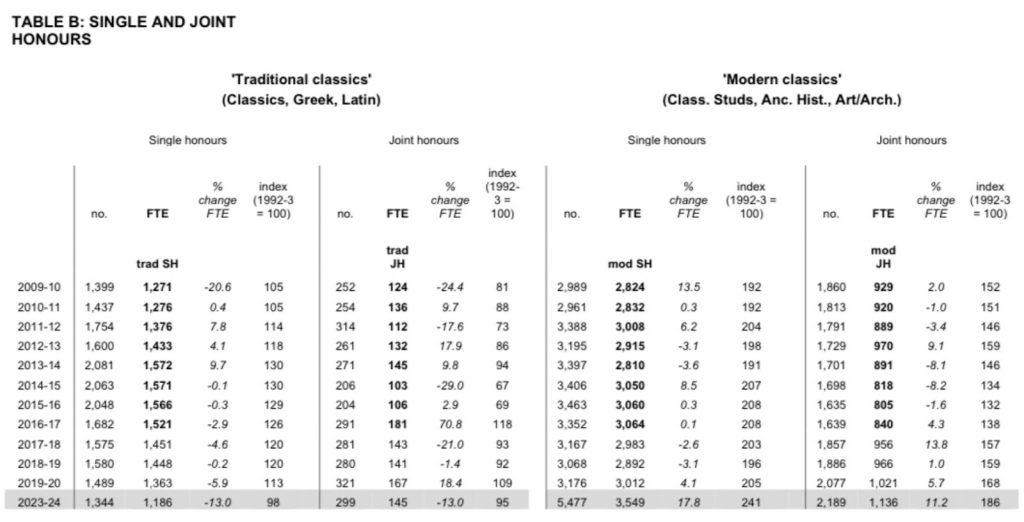
In this bulletin, it is clear from table B that there was a dramatic decrease in students taking ‘Traditional Classics’ (the study of Ancient Greek and Latin) from 2009 to 2023/4 in both joint honour and single honour students (-13% for each respectively). But when looking at ‘Modern Classics’ (this is where the degree shifts away from a language focus, and looks at the wider classical world. Degree titles for ‘Modern Classics’ include: Classical Studies, Ancient History, and Classical Art and Architecture), we can see that there was an increased intake of students (+17.8% for single honour students, and +11.2% for joint honour students) from all degree courses between 2015 to 2023/4.
With this conflicting information, I believed it would be best to discuss the fate of Classics with the head of the Classics Department at Royal Holloway, Professor Christos Kremmydas.
Christos has been the head of the department since 2022, and has been able to see a variety of trends in student intake.
Christos first began by saying that the Classics Department here at Royal Holloway has existed since the university’s foundation in 1886, and Greek and Latin was taught at Bedford College – one of the colleges that make up Royal Holloway; the Classics Department is “historic, but also healthy, dynamic and forward-thinking” and is valued by the Senior Leadership Team at Royal Holloway. The long lasting success of the department, as Christos puts it, is due to the “fantastic team of dedicated staff members… that work very well together”, as well as other factors like a curriculum which “engages with contemporary issues and concerns”. He also highlights that the Classics Department at Royal Holloway is not abandoning the classical languages. As a result of all of these factors, the department has done extremely well in the National Student Survey among other student surveys, and in the National League Tables. According to The Complete University Guide, Royal Holloway’s Classics Department is 9th in the country (up 7 places from 2025).
So why is Royal Holloway’s Classics Department doing so well in comparison to universities like Roehampton or Cardiff? Well, Christos argues that it might be a multitude of factors which include “demographic changes, political decisions, and ideological trends”. He also suggests that Classics is taking on more students at GCSEs and A-levels in comparison to other humanities subjects, like English or Drama.
Additionally Christos said that “[other] university management teams have tried to ‘resolve’ what they saw as problems (e.g. lower recruitment combined with higher expenditure creating ‘deficits’) by cutting programmes and departments and in some cases even making academics redundant in order to save money.” This is also taking place in a time when “the media is also maintaining a rather unhealthy and damaging narrative about the lack of relevance of Humanities subjects, whilst governments have been aggressively pushing STEM subjects for a long time.” With rivalries between STEM and Humanities subjects, as well as a financial deficit, it is not surprising to see humanities subjects like Classics being threatened out of the academic sphere.
While it is important to acknowledge the success of Royal Holloway’s Classics Department, I believe it is just as important to recognise the loss of other departments. No matter what, this is a loss that impacts the whole academic community, from students to staff. Without academics, we will lose something as a society; as the so-called ‘brain drain’ looms, we cannot afford to lose more academics before they get the chance to engage with academia. Christos implores other universities to “think twice and give departments space and time to reflect, innovate and identify solutions to any problems they might be facing. The tragedy is that very often universities are looking to make short-term gains whilst disregarding the long-term value of subjects.”
But I want to end on Christos’ optimistic outlook; even while he acknowledges the “current bleak context of UK Higher Education”, we must hope that Classics (and the wider schools of humanities) will be given “the space to thrive, grow and innovate”. We cannot, and will not, give up on humanities.
For Bulletin 53 of the CUCD (with Statistics), please go to:
https://cucd.blogs.sas.ac.uk/files/2025/09/CUCD-Bulletin-2025.08-Statistics-2024-25.pdf
Image via unsplash