

By Madeline Sidgwick, Senior News Editor
Last academic year, over some Crosslands pints, myself and my peers came to the conclusion that Royal Holloway is not a politically active campus. It is a common stereotype that Brits are their most politically active, and adventurous, in their student years; archetypes of student protestors or the leaders of political societies that go on to take high office (the Jeremy Corbyn and Boris Johnson’s of the world). Many in the older generation would point to their youth as their time of being ‘politically radical’ or ‘waving the red flag’. Winston Churchill himself can be quoted stating ‘If you are not a Liberal when you are young, you have no heart, If you are not a Conservative when old, you have no brain’.
Now I am not endorsing Mr Churchill here, but simply illustrating how our campus does not see this stereotypical student activism in the way that so many other universities do. It is important to note that I am not speaking on international issues. We have seen the undeniable efforts of societies such as Friends of Palestine Society and Amnesty International Society when promoting their beliefs in international causes. Amnesty International Society’s Vice President was in high appraisal of “how aware some students are of some of the most awful atrocities in the world today, and how they can help to end them” .
The focus of this investigation is to steer away from discussing British Politics and political discussion more broadly, when we are located so close to the UK’s political centre – Westminster.
Upon conducting a survey on campus, my assumptions regarding the apolitical nature of the Royal Holloway campus were proved to be staunchly correct. It was revealed that around 73.1% of those who took the survey did vote in the 2024 UK General Election. The primary reasons for not voting surrounded eligibility and age restrictions. However, the reasons behind casting the vote became concerning. When asked why they deemed it important to vote in the last election, many expressed their motivations behind voting as wanting to end fourteen years of Conservative government. This reveals how students did not feel they were voting for something, rather that they were voting against something else. Politics should not be about replacing an evil with a lesser deemed evil: young people should be able to feel that they support and advocate for whichever party was lucky enough to receive their mark on the ballot. It was also revealed that 65% of students are not members of a political party and would not even consider themselves to be loyal to a specific party. So we must ask, are young people at fault for their own political apathy and disengagement or is there a larger scale issue at play here?
The Orbital had the opportunity to interview our local parliamentary representative, Jack Rankin MP, who has represented the Windsor constituency since July 2024 for the Conservative Party. The Royal Holloway Campus and Englefield Green are within Jack’s constituency boundaries. Upon asking Jack about why he feels young people are increasingly apolitical and alienated from political discourse, he pointed to a decline in “enlightenment values”. Jack stated that the “decline in having a good disagreement is a huge shame”. I discussed with Jack the findings of my survey and he sympathised with the multitude of challenges that students face today. Perhaps it is down to increased rent, lack of graduate jobs and social media pressure, that prevents students from possessing the time to engage with political discussion. Jack argued that once economic growth is underway, “Britain will be more attractive to young people” and therefore they will be more willing to engage.
It must also be raised how scared students are to be disagreed with or “cancelled” for having a political opinion. One anonymous student, when asked why they do not get involved with campus politics, answered “I am worried that the people I know who disagree with me on politics will see and hate me or I will become a target.” Another expressed that they “would be worried of someone treating [them] differently based on what they perceived [their] political ideas to be because of generalised politics”. This reluctance to engage within political discussion at the hands of perception was mirrored when The Orbital reached out to Royal Holloway’s politically affiliated societies for their opinion on the issue.
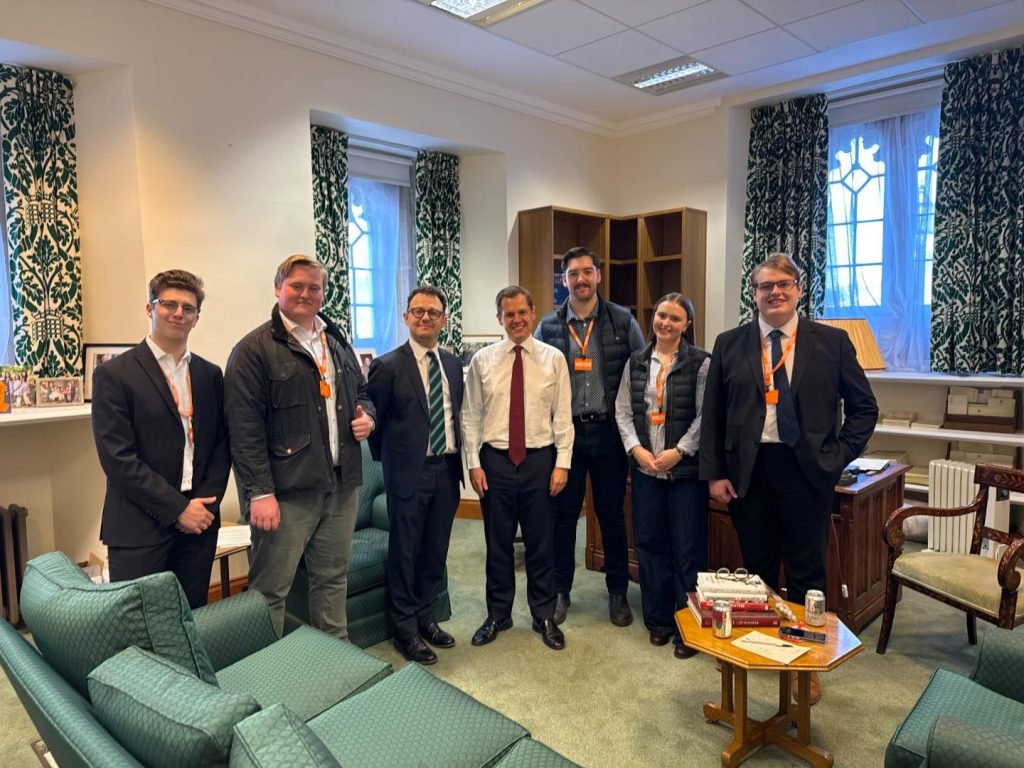
Upon asking for a statement from Royal Holloway Labour Society, Liberal Association and Conservative Association it became evident that political disengagement has affected all of the politically affiliated societies individually.
Royal Holloway’s Liberal Association told The Orbital ,“General reluctance to participate in party political stems, it seems, from a fear of being judged by those with other viewpoints and that future career prospects, preferring instead the ‘safety net’ of political neutrality.” The Liberal Association also highlighted that “Many people join political clubs at university and then change their ideological beliefs later on in life, (a natural and not-unusual human tendency) and still go on to have brilliantly successful careers in a broad range of industries, including elected public office”. Thus proving that the political position that you take in your youth does not bind you to that party or idea for the rest of your life.
It is most clear through the dissolution of the RHUL Labour Society for a period in 2025, whilst the UK had a Labour government, that students are politically alienated. Lottie, the new Labour Society President, told The Orbital that “there are pockets of political activity on campus”. Upon contacting former RHUL Labour Society President and now Labour and Co-operative Party Councillor for Chertsy Riverside, Cai Perry told The Orbital “Campus is quite contained, which I think is a real shame! So, even though there certainly are a lot of students interested in politics on campus, they don’t naturally get signposted to a forum in the wider community to put that into action”.
This was also reflected within my interview with Jack Rankin MP. Jack emphasised the significance of “come (ing) into the real world and engage(ing) with what you believe in”. It thus becomes clear that students are not only apathetic on campus, but are also disengaged from local communities and disinterested in real-world political action. Royal Holloway students must first engage with what is on offer on campus, and then look to the vortex that is the post-graduate real world.
The efforts of all three politically affiliated societies, alongside Royal Holloway Debating Society, to host events centered around the policy of debating and “agreeing to disagree” must be commended. The two successful ‘Parliamentary Debates’ also make evident that Royal Holloway can be political, our campus just needs the additional push.
President of the Royal Holloway Conservative Association, George Kelly told The Orbital, “All three political societies at Holloway alongside debating society have done an amazing job over the last year to get people engaged and discussing political issues, debating hot topics and sharing a common interest (…) my main aim was to create discussion between the societies and all students on campus that are interested in politics, and fight the growing apathy and disengagement, with the help of many other brilliant like-minded students across the political spectrum and other societies, we have created a space that encourages discussion and is thriving with political engagement”. So perhaps safe spaces such as the Debating Society are the answer to our apolitical problem.
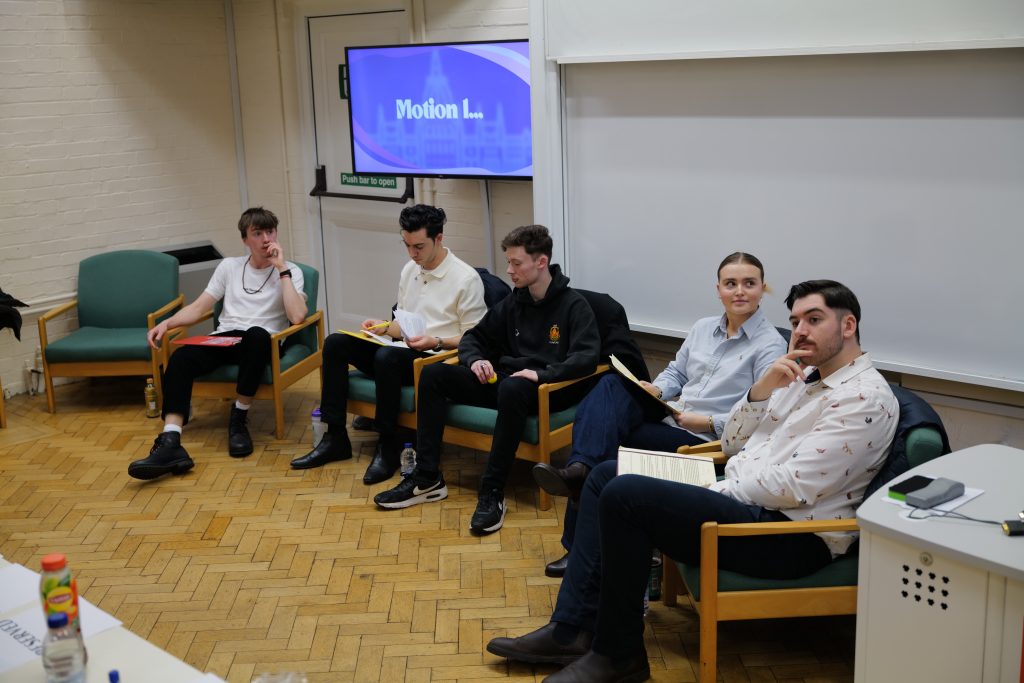
A recent report by The Times analysed the value in the government’s plans to push for Debate Clubs in schools. The report presented how Education Secretary Briget ‘Phillipson is aiming to fight the deteriorating communication skills of young people in Britain’. Perhaps gen-z’s fear of political discussion can also be rooted in a broader fear of public speaking and confrontation.
To round up my investigation I asked students what they believed the university could do in order to aid the issue of apoliticality on campus. One student suggested “the university should increase students’ awareness of current affairs, rather than force anyone to suddenly formulate a political view”. Multiple students emphasised the significance in promoting the politically affiliated societies on our campus. Perhaps the student union could provide more openly advertised safe political spaces, and make it evident that ‘safe’ and ‘political’ are not perceived as oxymoronic on campus.
I urge all readers to attend the socials of any of the politically affiliated societies. You do not immediately have to be the loudest in any room – whether that is a Left Soc talk evening or a cross-party social at the Armstrong Gun. Showing up to political discussion is of undeniable importance. If you feel you do not know what to believe in: talk to your peers, ask locals in your area questions. Take this time to break out of your comfort zone and utilise the privilege that is the educational bubble and seek out political conversation.
By the end of my degree I hope to, yet again, be sat outside of Crosslands in the term three sun, but this time discussing an overheard political discussion from the international building or the mass attendance of a political event and engaging with productive political discussion more so myself.
Image Credit: Unsplash: Mr Cup / Fabien BarraMr Cup / Fabien Barra